



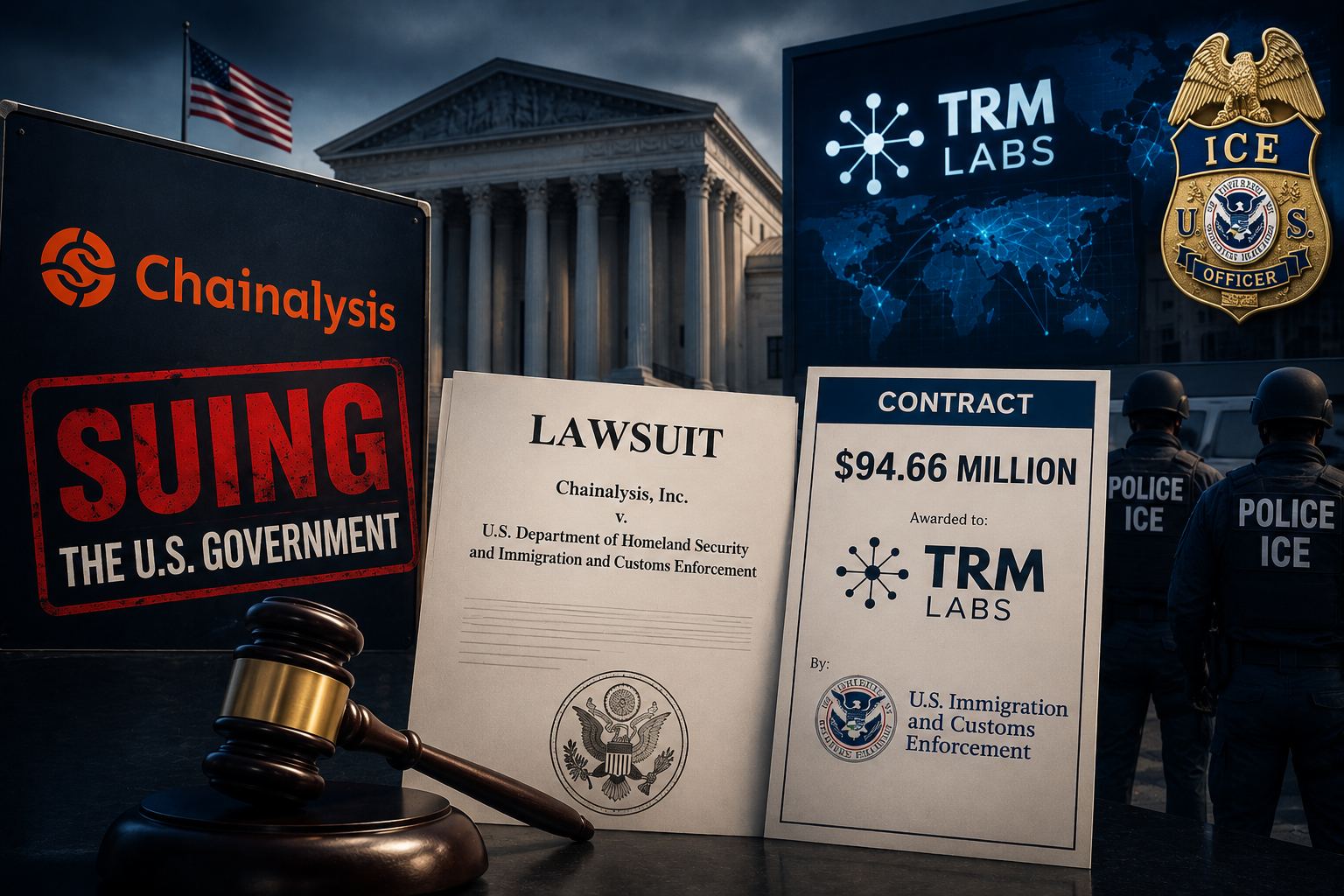
Chainalysis has filed a lawsuit against the U.S. government, challenging a decision by U.S. Immigration and Customs Enforcement (ICE) to award competitor TRM Labs a $94.66 million blockchain analytics contract without a full and open competition.
The company claims that potential vendors were evaluated against criteria that were not fully disclosed in the official requirements document. According to Chainalysis, some of the procurement conditions may have closely matched existing TRM Labs products and commercial partnerships.
Chainalysis is also challenging the procurement process itself. Alternative suppliers were given only three days to prepare a response and were limited to a one-page description of their capabilities.
Chainalysis Challenges a Major TRM Labs Contract
The contract requires TRM Labs to provide ICE with specialized blockchain investigation software and related technical support. According to federal records, the agreement runs from July 1, 2026, through June 30, 2027.
Chainalysis describes it as the largest blockchain analytics contract ever awarded by the U.S. government. The company argues that ICE structured the procurement process in a way that may have given TRM’s existing infrastructure an advantage over potential competitors.
The dispute primarily centers on differences between a request for information published by ICE in May and a later document outlining the agency’s final requirements.
On May 28, ICE issued a request containing 18 questions about the technical capabilities of potential vendors. Companies were given until June 2 to submit their responses.
ICE Requested Highly Specialized Capabilities
In its initial request, the agency asked whether vendors had access to several highly specific technologies and resources.
Among other things, ICE wanted to know whether companies maintained a proprietary database containing more than one million reports from fraud victims, operated an artificial intelligence-powered investigation platform, and could automatically track the movement of suspicious cryptocurrency funds.
Other capabilities included automatically notifying virtual asset service providers when flagged funds moved downstream, as well as enabling those providers to voluntarily hold assets without separate human coordination for each individual event.
ICE also asked about operational partnerships with stablecoin issuers that could be used to coordinate asset freezes with international law enforcement agencies.
However, the document itself stated that the request was intended solely for market research and procurement planning and was not a formal solicitation.
Competitors Were Given Only Three Days
On June 8, ICE announced its intention to award the contract directly to TRM Labs. Other companies were allowed to challenge the decision by demonstrating that they could also meet the agency’s requirements.
Potential competitors, however, were given only three days to respond, and their capability statements were limited to one page.
According to Chainalysis, it was the only alternative vendor that attempted to challenge ICE’s conclusion.
On June 11, Chainalysis Government Solutions submitted a one-page statement outlining the capabilities of its platform. The following day, ICE completed its market research and concluded that TRM Labs was the only vendor capable of meeting all operational, technical, and data requirements.
Chainalysis claims that ICE did not request any additional clarification or ask follow-up questions before making its decision.
The Final Requirements Differed From the Initial Request
According to Chainalysis, ICE’s final Statement of Need differed substantially from the May request for information.
The document identified three broader mission areas: fraud disruption, cybercrime disruption, and combating extortion-related activity.
ICE said it needed tools for AI-based complaint triage, real-time screening of fraudulent wallets, tracing and recovering digital assets, and identifying infrastructure associated with ransomware operations.
However, many of the more specific requirements included in the original request for information were absent from the final document.
Chainalysis argues that despite these omissions, ICE continued to rely on the earlier, narrower criteria when determining whether an alternative vendor could compete with TRM Labs.
Chainalysis Says Some Criteria Closely Matched TRM Products
The lawsuit alleges that certain ICE requirements closely resembled infrastructure already offered by TRM Labs.
One example involves a mechanism for automatically notifying cryptocurrency service providers when flagged funds move downstream and allowing those platforms to voluntarily hold the assets.
Chainalysis says this description closely resembles the architecture of the TRM Beacon Network, a systеm designed to enable rapid coordination between law enforcement agencies, cryptocurrency exchanges, and other market participants.
When justifying its selection of TRM, ICE also cited the company’s proprietary fraud victim database, AI-powered investigation platform, automated mechanisms for handling suspicious assets, partnerships with stablecoin issuers, and trained workforce.
Chainalysis disputes the claim that all of these capabilities are exclusive to TRM and argues that some of them were never clearly identified as mandatory requirements for potential competitors.
Chainalysis Points to Inconsistencies in ICE’s Requirements
Chainalysis also notes that extortion was not mentioned in any of the 18 questions included in the original request for information. However, combating extortion later became one of the three central mission areas in ICE’s final requirements document.
The company views this change as further evidence that the agency’s requirements shifted or were applied inconsistently throughout the procurement process.
According to Chainalysis, vendors were effectively evaluated using a combination of requirements from two different documents without clear guidance on which criteria were actually mandatory.
Chainalysis Acknowledges Differences in Its Platform
At the same time, Chainalysis acknowledges that its platform does not provide an exact replica of the automated notification and voluntary asset-hold mechanism described in ICE’s request.
Instead, Chainalysis says its approach places greater emphasis on coordination with law enforcement before a cryptocurrency platform is asked to freeze or hold assets.
The company argues that this approach could still effectively achieve ICE’s core objectives, but claims that the agency did not fully evaluate the alternative or explain why it was considered insufficient.
Chainalysis also says it could have expanded its fraud victim database, developed additional automated notification capabilities, and established the required partnerships if ICE had clearly identified those functions as mandatory requirements in advance.
Chainalysis Demands a Full and Open Competition
Chainalysis initially challenged ICE’s decision through the U.S. Government Accountability Office. The protest was filed on July 12.
After ICE provided its sole-source justification and market research report, Chainalysis withdrew the GAO protest on July 21 and moved the dispute to the U.S. Court of Federal Claims.
The company is now asking the court to declare the direct award to TRM Labs unlawful, block further performance of the contract, and require ICE to conduct a full and open competition.
TRM Labs has intervened in the case to defend its contract. The court has not yet ruled on the merits of Chainalysis’ allegations.
Oral arguments are scheduled for September 2. The outcome could prove significant not only for Chainalysis and TRM Labs, but also for the broader market for government blockchain analytics contracts.
Why the Dispute Matters for the Blockchain Analytics Industry
Blockchain analytics platforms are becoming increasingly important tools for government and law enforcement agencies. They are used to trace cryptocurrency transactions, analyze suspicious wallets, investigate fraud, ransomware, and other forms of financial crime.
As digital assets grow, government contracts in this sector are becoming larger and technical requirements more complex. As a result, transparency in procurement procedures and equal access to information can play an important role in maintaining competition in the market.
The dispute between Chainalysis and ICE therefore goes beyond a single $94.66 million contract. It raises a broader question about how clearly government agencies should disclose technical requirements and whether procurement criteria can unintentionally favor the existing products of a particular vendor.