



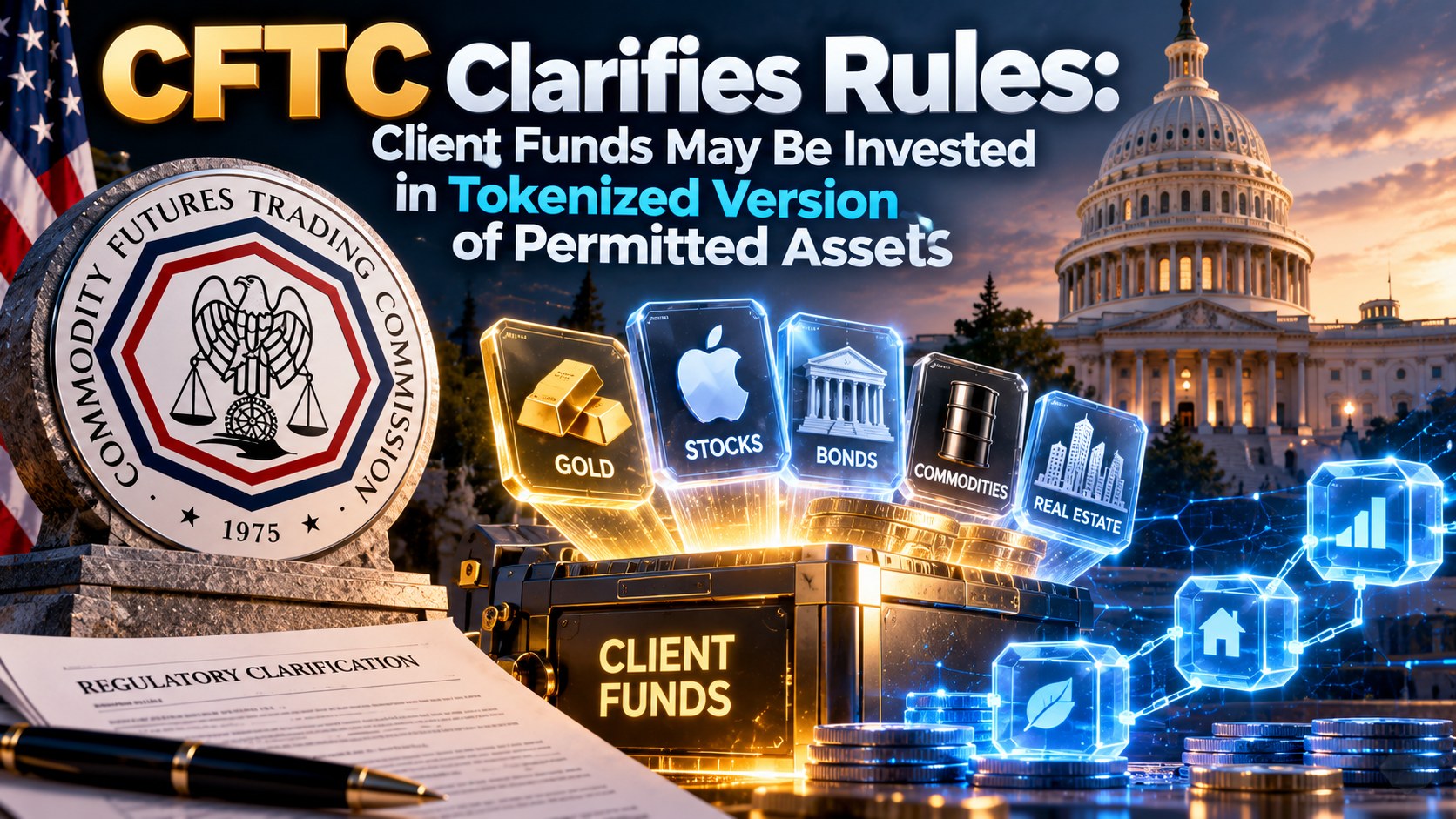
The U.S. Commodity Futures Trading Commission (CFTC) has updated its guidance for regulated market participants, clarifying how tokenized assets and blockchain infrastructure may be used. The new guidance allows futures commission merchants (FCMs) and derivatives clearing organizations (DCOs) to invest customer funds in tokenized versions of financial instruments that are already permitted investments. ([cftc.gov](https://www.cftc.gov/PressRoom/PressReleases/9303-26?utm_source=chatgpt.com))
Importantly, this does not mean firms are free to invest customer funds in any crypto asset. The underlying instrument must still satisfy CFTC requirements, while its tokenized version must retain the necessary legal and economic characteristics. The updаte itself represents the regulator staff’s position and does not create a separate new law or a universal exemption from existing rules. ([lowenstein.com](https://www.lowenstein.com/news-insights/publications/client-alerts/cftc-divisions-updаte-faqs-on-crypto-assets-and-blockchain-technologies?utm_source=chatgpt.com))
At the same time, the CFTC clarified that regulated firms may use blockchain and distributed ledger technology to satisfy certain recordkeeping requirements, provided they continue to meet existing standards for accessibility, reliability, and the ability to provide records to regulators. ([cftc.gov](https://www.cftc.gov/PressRoom/PressReleases/9303-26?utm_source=chatgpt.com))
What Exactly Changed for Brokers and Clearing Organizations
CFTC rules already allow FCMs and DCOs to invest certain customer funds in a limited range of instruments. These inсlude, among other things, certain government securities, permitted money market funds, and other assets that satisfy the requirements of Regulation 1.25. ([cftc.gov](https://www.cftc.gov/LawRegulation/FederalRegister/finalrules/2024-30927.html?utm_source=chatgpt.com))
The updated guidance effectively confirms a technology-neutral approach: if a traditional financial instrument is permitted for the investment of customer funds, its tokenized version may also be used as long as it meets the same regulatory requirements.
Restrictions related to liquidity, maturity, asset concentration, custody, and preservation of customer principal remain in force. In other words, tokenization changes the form in which an asset is represented, but it does not remove the requirements that apply to the asset itself. ([lowenstein.com](https://www.lowenstein.com/news-insights/publications/client-alerts/cftc-divisions-updаte-faqs-on-crypto-assets-and-blockchain-technologies?utm_source=chatgpt.com))
The updаte Does Not Allow Customer Funds to Be Invested in Any Cryptocurrency
The CFTC’s wording is considerably narrower than the headline may suggest. The regulator did not add Bitcoin, Ether, stablecoins, or other crypto assets to the general list of permitted customer-fund investments simply because they exist on a blockchain.
Previous CFTC guidance separately noted that rules concerning digital collateral do not, by themselves, expand the list of eligible investments under Regulation 1.25. The same principle remains in place under the updated position: the tokenized asset must represent an instrument that is already permitted, rather than just any digital asset. ([cftc.gov](https://www.cftc.gov/media/13521/Registrant%26RegisteredEntity_FAQs032026/download?utm_source=chatgpt.com))
The key change therefore concerns recognition of tokenized forms of financial instruments and blockchain infrastructure within the existing regulatory framework.
CFTC Also Allows Blockchain-Based Regulatory Recordkeeping
Another important part of the updаte concerns recordkeeping. CFTC staff confirmed that existing reporting and record-retention requirements are technology-neutral.
This means firms may create and store required records directly on a distributed ledger, provided the systеm ensures the authenticity, reliability, and accessibility of the information and allows it to be promptly provided to regulators in the required format. ([lowenstein.com](https://www.lowenstein.com/news-insights/publications/client-alerts/cftc-divisions-updаte-faqs-on-crypto-assets-and-blockchain-technologies?utm_source=chatgpt.com))
The fact that records are stored on a blockchain does not automatically require firms to maintain a separate off-chain copy. However, a company must still be able to access and produce those records even if a public network or third-party blockchain explorer experiences technical problems. ([tradeinformer.com](https://www.tradeinformer.com/regulations/cftc-clarifies-tokenized-funds-blockchain-recordkeeping?utm_source=chatgpt.com))
Regulators Accelerated Their Work After the Failed CLARITY Act Vote
The updаte came shortly after the U.S. Senate failed to advance the Digital Asset Market Clarity Act. On September 15, a procedural cloture vote ended with 49 votes in favor and 50 against, while three-fifths of the Senate was required to move the legislation forward. ([senate.gov](https://www.senate.gov/legislative/LIS/floor_activity/09_15_2026_Senate_Floor.htm?utm_source=chatgpt.com))
The failed vote does not mean the legislation has been permanently abandoned. Senator Thom Tillis filed a procedural motion to reconsider the result, leaving open the possibility of another vote. ([senate.gov](https://www.senate.gov/legislative/LIS/floor_activity/09_15_2026_Senate_Floor.htm?utm_source=chatgpt.com))
With legislation delayed, the SEC and CFTC have continued using their existing authority to clarify how crypto and tokenized markets should operate. Disagreements over the CLARITY Act remain political. For example, Democratic Senator Ruben Gallego said negotiations over ethics provisions were cut short by Republican leadership, while supporters of the bill have offered their own explanations for why the vote failed. ([gallego.senate.gov](https://www.gallego.senate.gov/news/press-releases/gallego-statement-on-failed-clarity-act-cloture-vote/?utm_source=chatgpt.com))
SEC Opened the Door to Limited Trading of Tokenized Stocks
One of the most significant developments came from the SEC on September 17. The commission granted temporary and conditional exemptions for certain Tokenized Securities Venues, allowing them to facilitate on-chain trading of some tokenized U.S. NMS stocks. ([sec.gov](https://www.sec.gov/newsroom/press-releases/2026-90-sec-issues-innovation-exemption-facilitate-trading-tokenized-nms-stock-request-comment?utm_source=chatgpt.com))
The exemption is limited in scope and does not remove securities-market regulation as a whole. The SEC has described the framework as a temporary mechanism intended to test new trading models while the commission considers more permanent rule changes. ([sec.gov](https://www.sec.gov/newsroom/speeches-statements/atkins-innovation-exemption-bridge-toward-durable-rulemaking-091726?utm_source=chatgpt.com))
In this way, both the SEC and CFTC are gradually developing rules that allow traditional financial instruments to use blockchain infrastructure without creating an entirely separate regulatory systеm.
CFTC Also Eased Its Approach to Passive Software Providers
On September 17, the CFTC issued a separate no-action position covering certain providers of “passive software”. Subject to specified conditions, developers of such software do not need to register as introducing brokers solely because their software helps users interact with registered FCMs, brokers, and regulated trading venues. ([cftc.gov](https://www.cftc.gov/PressRoom/PressReleases/9300-26?utm_source=chatgpt.com))
The measure builds on an approach previously applied by the CFTC to Phantom, a non-custodial crypto wallet developer. In March 2026, the regulator also stated that, under certain conditions, it would not recommend enforcement action for failure to register as a broker solely because a company provides this type of software interface. ([cftc.gov](https://www.cftc.gov/PressRoom/PressReleases/9197-26?utm_source=chatgpt.com))
Together, these decisions show that the regulator is attempting to distinguish between companies directly providing regulated financial services and software developers that merely provide technical access to those services.
The CLARITY Act Remains Part of the Legislative Agenda
Despite the failed September procedural vote, the bill has already received substantial support in the House of Representatives. In July 2025, the House approved the CLARITY Act by a vote of 294 to 134. It was supported by 216 Republicans and 78 Democrats. ([clerk.house.gov](https://clerk.house.gov/Votes/2025199?utm_source=chatgpt.com))
After the September vote, a group of Democratic senators involved in the negotiations also said they remained committed to working on bipartisan crypto market-structure legislation despite disagreements over the specific version of the bill. ([gallego.senate.gov](https://www.gallego.senate.gov/news/press-releases/gallego-colleagues-issue-statement-on-continued-commitment-to-pass-clarity-act/?utm_source=chatgpt.com))
The current situation is therefore more accurately described as a pause in the legislative process rather than the definitive end of the CLARITY Act, while federal agencies continue to clarify the use of their existing authority.
Agency Guidance Does Not rеplace Legislation Passed by Congress
SEC and CFTC guidance and temporary exemptions can affect market practices immediately, but their legal durability differs from that of federal legislation enacted by Congress.
For example, the CFTC’s updated FAQs reflect the views of agency staff and do not themselves amend the Commodity Exchange Act or the commission’s existing regulations. Similarly, the SEC’s Innovation Exemption is explicitly temporary and conditional. ([lowenstein.com](https://www.lowenstein.com/news-insights/publications/client-alerts/cftc-divisions-updаte-faqs-on-crypto-assets-and-blockchain-technologies?utm_source=chatgpt.com))
This is why the future of the CLARITY Act remains important for the industry. Legislation could establish a more durable division of responsibilities between the SEC and CFTC, while administrative interpretations and exemptions may potentially be revised by future agency leadership.
Tokenization Is Gradually Being Integrated Into the Existing Financial systеm
The latest CFTC updаte does not create a separate regulatory regime for an entirely new category of assets. Instead, the regulator is taking another step toward allowing existing financial instruments to be issued, held, and recorded using blockchain technology.
For regulated brokers and clearing organizations, this means they may be able to work with tokenized versions of already permitted assets while continuing to comply with existing customer-fund protection requirements.
For the broader market, the trend shows that U.S. digital-asset regulation is developing along two tracks at the same time: Congress continues to debate a comprehensive legislative framework, while the SEC and CFTC are simultaneously adapting existing rules to tokenization and blockchain infrastructure.