



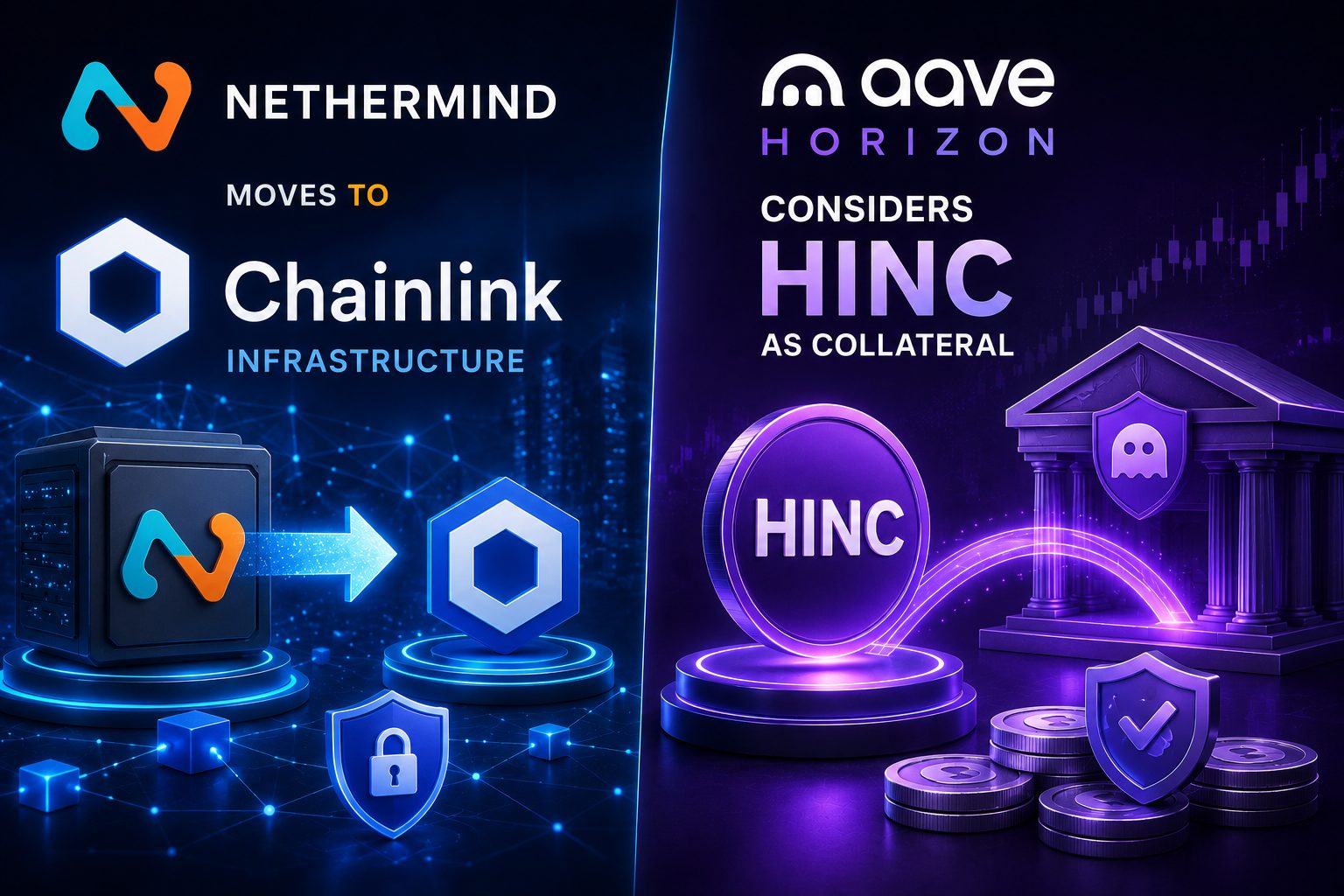
Nethermind, one of the most prominent infrastructure companies in the Ethereum ecosystem, has decided to discontinue support for its own legacy cross-chain technology and move to Chainlink infrastructure. The decision was announced through Chainlink’s official account on X. Following a technical review, Nethermind chose deeper integration with the Chainlink ecosystem and will join not only as a user of the technology, but also as a full infrastructure partner.
The company will become a Chainlink node operator and participate in securing the Cross-Chain Interoperability Protocol (CCIP) and Chainlink Data Streams. In addition, Nethermind will contribute to the development of new tools, libraries, templates, and integration solutions designed to simplify the use of Chainlink by institutional participants and blockchain developers.
For the market, the decision is notable because Nethermind is not simply adding support for another protocol. The company is effectively changing its own cross-chain strategy. Instead of continuing to maintain a separate infrastructure for communication between blockchains, Nethermind is choosing to build around an existing and actively developing Chainlink standard.
Why Nethermind Chose Chainlink
Nethermind is best known as the developer of one of the largest Ethereum execution clients. Its software is used by Ethereum network participants to run nodes, process transactions, and interact with the blockchain. This gives Nethermind an important role in Ethereum’s technical infrastructure and extensive experience with the performance, reliability, and security requirements of blockchain systems.
Cross-chain interoperability remains one of the most technically challenging areas of the industry. Different blockchains need to exchange data, messages, and assets, but every additional connection increases architectural complexity and potentially creates new security vulnerabilities. Maintaining proprietary cross-chain technology therefore requires continuous updates, audits, new integrations, and significant engineering resources.
After evaluating the available options, Nethermind decided to focus on Chainlink. The move allows the company to retire its legacy solution and redirect resources toward tools built around infrastructure already used by numerous DeFi projects, financial institutions, and developers of tokenized assets.
The partnership is also important for Chainlink. Nethermind has a strong engineering team and deep expertise in Ethereum, meaning its participation could strengthen the network’s technical foundation and expand the number of independent infrastructure operators.
Nethermind Will Become a Chainlink Node Operator
One of the main elements of the partnership will be Nethermind’s role as a Chainlink node operator. Node operators are a key part of the decentralized architecture because they participate in transmitting, validating, and processing data that is later used by smart contracts and blockchain applications.
Nethermind will help support CCIP — the Cross-Chain Interoperability Protocol. The protocol is designed to enable secure transfers of data, instructions, and tokens between different blockchain networks.
Instead of requiring developers to build a separate bridge for every pair of blockchains, CCIP aims to provide a unified interoperability layer. This allows applications to connect to multiple networks through standardized infrastructure and can reduce development complexity.
For large financial institutions, this approach may be especially important. If a bank, asset manager, or payments company wants to operate across several blockchains, it needs secure infrastructure for moving data and assets between them. A unified protocol could reduce the number of separate integrations and simplify infrastructure management.
What Is CCIP and Why Is It Important?
Chainlink CCIP is one of Chainlink’s key products in the cross-chain interoperability sector. Its goal is to establish a standard for exchanging messages and assets between independent blockchains.
The modern crypto market is no longer centered around a single network. Ethereum remains the largest smart contract platform, but significant activity also takes place on Solana, Avalanche, Arbitrum, Base, Optimism, and many other networks. At the same time, financial institutions are gradually creating their own blockchain systems and private networks.
In this environment, assets and data need to move between different platforms. For example, a tokenized fund could be issued on one blockchain, used as collateral on another, while settlement could take place through a third infrastructure layer.
Such operations require a reliable mechanism for cross-chain communication. Chainlink is trying to address this through CCIP by providing developers with a unified set of tools for transferring messages and value between networks.
If the use of tokenized assets continues to grow, the importance of these protocols is also likely to increase. For institutional participants, the ability to interact securely with multiple blockchains could become one of the key requirements when choosing infrastructure.
Nethermind Will Also Support Chainlink Data Streams
In addition to CCIP, Nethermind will participate in the operation of Chainlink Data Streams. This technology is designed to deliver high-frequency market data to smart contracts and decentralized applications.
Traditional price oracles often updаte data at specific intervals or after significant changes in an asset’s value. However, applications involving derivatives, perpetual futures, high-frequency trading, and more sophisticated financial products may require much faster data delivery.
Data Streams allows applications to access low-latency market information while preserving cryptographic verification of the data sources. This architecture is particularly relevant for modern DeFi platforms seeking execution quality closer to that of centralized trading venues.
Nethermind’s participation in Data Streams infrastructure could help Chainlink further improve systеm resilience and increase the number of independent participants supporting the network.
The Partnership Goes Beyond Technical Infrastructure
Nethermind will not only serve as a node operator but will also become a Chainlink ecosystem development partner. The companies plan to work on developer tools, ready-made templates, integrations, and infrastructure solutions.
This area could be particularly important for institutional adoption. For traditional financial companies, blockchain integration often involves significant technical complexity. They need to connect wallets, key-management systems, oracles, compliance tools, cross-chain protocols, and existing corporate infrastructure.
If these components are available as standardized libraries and ready-to-use modules, implementation can be significantly faster. Developing tools around CCIP and other Chainlink services could therefore become an important part of the partnership.
Nethermind already has extensive experience building tools for Ethereum developers, meaning it can use that expertise to create more convenient Chainlink integrations.
Chainlink Is Expanding Far Beyond Traditional Oracles
Chainlink originally became known as a decentralized oracle network. Smart contracts cannot directly access external information such as asset prices, stock market data, interest rates, or real-world events. Oracles solve this problem by delivering external data to blockchains.
Over time, Chainlink has significantly expanded its product suite. Today, the ecosystem includes solutions for price data, cross-chain communication, smart contract automation, Proof of Reserve, market data delivery, and infrastructure for tokenized assets.
This change in strategy is closely tied to growing institutional interest in blockchain technology. Traditional financial institutions need more than simple access to price oracles. They require infrastructure that can connect different blockchains, integrate with existing financial systems, and securely transfer data.
As a result, Chainlink is increasingly positioning itself as a universal infrastructure layer connecting traditional financial systems with blockchain networks.
LINK Remains a Key Economic Component of the Network
The LINK token plays an important role in the Chainlink ecosystem. It is used within the network’s economic model, including payments to node operators and incentives for infrastructure participants.
Chainlink is also developing a model in which part of the revenue generated from enterprise and on-chain use of its products can be converted into LINK and directed to a strategic ecosystem reserve.
The idea is to connect commercial use of Chainlink infrastructure with the economics of the token itself. If demand for CCIP, Data Streams, and other services continues to increase, the amount of fees and revenue flowing through the ecosystem could also grow.
Institutional adoption could be particularly important in this context. Unlike purely speculative activity, infrastructure integration by large companies often implies long-term use of services and more consistent transaction flows.
Chainlink Is Working With Major Financial Institutions
One of the reasons Chainlink is placing so much emphasis on CCIP and tokenization is the growing interest from traditional financial companies.
Chainlink technology has been used or tested in projects involving organizations and financial infrastructure providers such as SWIFT, DTCC, Euroclear, JPMorgan, Mastercard, UBS, SBI, Fidelity International, and ANZ.
Some projects have focused on interbank settlement, while others explored cross-chain data transfers, tokenized funds and securities, or digital asset management.
For Chainlink, these projects are important not only from a reputational perspective. They also provide opportunities to test infrastructure in scenarios that differ substantially from standard DeFi use cases.
Financial institutions operate under strict requirements related to security, reporting, interoperability, and risk management. If infrastructure can function reliably under these conditions, it becomes easier to adopt in other institutional projects.
Tokenization Is Becoming a Major Growth Driver
The market for tokenized real-world assets continues to expand. Tokenized government bonds, money market funds, private credit instruments, fund shares, gold, and other traditional assets are already represented on blockchains.
However, issuing a token is only the first step. A fully functioning financial ecosystem also needs infrastructure for transmitting prices, verifying reserves, settling transactions, moving assets between networks, and connecting with DeFi protocols.
For example, a tokenized fund could be issued on Ethereum, used as collateral in a lending protocol, and simultaneously made available to users on another blockchain. This requires a reliable cross-chain layer.
This is why Chainlink is closely linking the development of CCIP with tokenization. If the value of traditional assets represented on blockchains grows into the hundreds of billions or even trillions of dollars, cross-chain infrastructure could become increasingly critical.
Why Companies Are Moving Away From Proprietary Bridges
Nethermind’s decision to retire its own legacy cross-chain infrastructure reflects a broader trend in the blockchain industry. Building a proprietary bridge can be relatively straightforward at an early stage, but maintaining it over the long term requires significant resources.
Developers must constantly updаte code, add support for new blockchains, conduct security audits, and monitor potential vulnerabilities. At the same time, cross-chain bridges have historically been among the most frequently targeted components of cryptocurrency infrastructure.
Over the past several years, bridge exploits have repeatedly resulted in major losses. One reason is that these systems often control large amounts of assets while interacting with multiple blockchains, which substantially increases technical complexity.
Against this backdrop, more development teams are choosing specialized infrastructure providers whose primary focus is cross-chain communication rather than building separate systems from scratch.
Nethermind’s move suggests that even large technical teams may choose not to maintain proprietary interoperability technology when adopting a shared standard is more efficient.
The Cross-Chain Market Is Gradually Consolidating
During the early development of the multichain ecosystem, many blockchains and projects created their own bridges. This resulted in a large number of incompatible systems, each using its own security architecture.
The market is now gradually moving toward standardization. Instead of relying on dozens of separate solutions, more projects are considering a smaller number of major interoperability protocols.
This consolidation can benefit developers by reducing the number of integrations they need to maintain. If an application can connect to one protocol and use it to interact with dozens of blockchains, development becomes significantly simpler.
For institutional clients, this could also simplify risk assessment. Evaluating the security of a few major infrastructure standards is considerably easier than conducting separate reviews of a large number of smaller bridges.
What the Partnership Means for Nethermind
For Nethermind, moving to Chainlink allows it to free up engineering resources that were previously used to maintain its own cross-chain infrastructure.
The company can instead focus on its core areas, including its Ethereum client, developer tools, infrastructure products, and institutional solutions.
At the same time, Nethermind will remain active in the cross-chain sector, but now through support for Chainlink infrastructure.
This approach may be more efficient because the company gains access to an established ecosystem of users, developers, and financial institutions.
What the Partnership Means for Chainlink
For Chainlink, Nethermind’s participation strengthens both the technical and strategic sides of the ecosystem.
First, the network gains a new node operator with a strong engineering reputation and extensive Ethereum experience. This may improve infrastructure resilience.
Second, Chainlink gains a partner capable of creating tools and integrations for developers. This could accelerate the adoption of CCIP and other services.
Third, Nethermind’s decision to rеplace its proprietary technology with Chainlink can be viewed as an additional signal that CCIP is gaining importance as an industry interoperability standard.
The more major infrastructure companies adopt the same protocol, the stronger the potential network effects may become.
Chainlink Strengthens the Connection Between TradFi and DeFi
The partnership between Nethermind and Chainlink reflects a broader direction in the development of the cryptocurrency market. DeFi is gradually becoming more connected with traditional finance, while large institutional companies are increasingly testing blockchain technology for settlement, custody, tokenization, and asset transfers.
Connecting these two worlds requires infrastructure that can operate across both public blockchains and traditional financial systems.
Chainlink is attempting to occupy this position by developing not only oracles but also CCIP, Data Streams, Proof of Reserve, and other products.
Nethermind, meanwhile, brings deep Ethereum expertise and could help adapt this infrastructure to the requirements of developers and institutional users.
What Could Happen Next
If the partnership proves successful, Nethermind could become an important technical participant in the Chainlink ecosystem. Together, the companies may develop new tools for cross-chain communication, tokenization, and institutional blockchain products.
The tokenized asset market remains one of the most promising areas. Banks and asset managers are gradually bringing bonds, funds, and other instruments onto blockchains, but large-scale adoption will require reliable infrastructure connecting different networks.
If CCIP establishes itself as one of the main standards in this segment, demand for node operators, data services, and developer tools could also increase.
In this context, Nethermind’s decision to discontinue its proprietary cross-chain systеm looks less like a simple technical upgrade and more like a strategic shift toward a larger and more standardized infrastructure.
Nethermind Backs a Shared Cross-Chain Standard
Nethermind’s move to Chainlink shows how the blockchain industry is gradually transitioning from numerous fragmented solutions toward more universal standards.
For users, this could eventually mean more convenient and secure interaction between networks. For developers, it could mean fewer separate integrations and simpler application maintenance. For institutional participants, it may provide a more understandable infrastructure that can scale across multiple blockchains.
For Chainlink, the partnership with Nethermind represents another step toward strengthening its position as a foundational infrastructure layer for transferring data and assets between blockchain networks.
If tokenization and multichain development continue to expand, the importance of protocols like CCIP is likely to increase. In such an environment, CCIP could become one of the key tools connecting Ethereum, other public networks, DeFi protocols, and traditional financial systems into a unified infrastructure.