



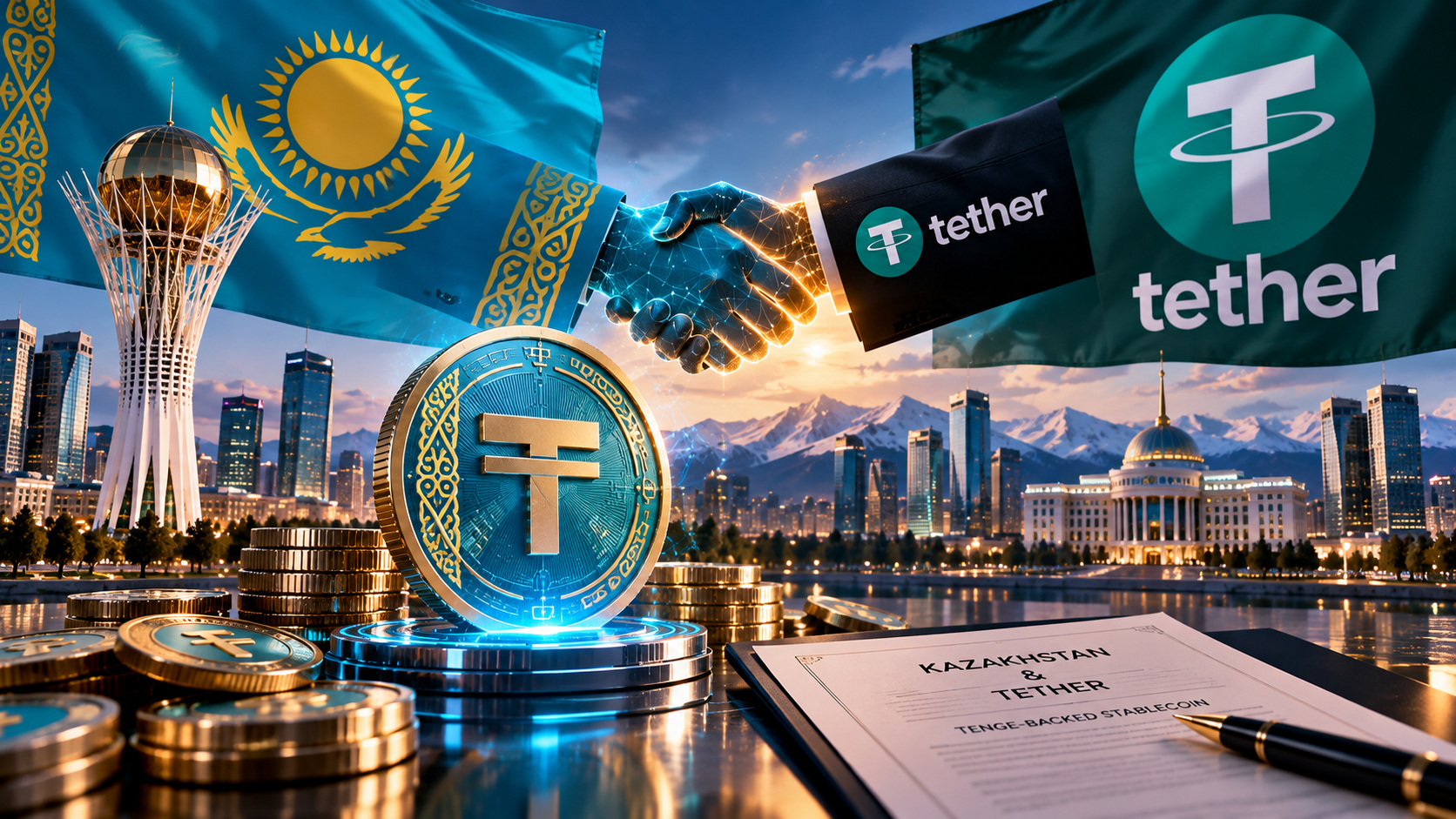
The National Bank of Kazakhstan, Tether, and the administration of Alatau have agreed to jointly explore the possibility of creating a stablecoin pegged to the Kazakhstani tenge, as well as projects involving the tokenization of real-world assets. The parties signed a memorandum of understanding that will serve as a framework for further research and potential pilot initiatives.
The agreement covers several areas, including stablecoins, asset tokenization, and decentralized finance technologies. At this stage, however, the initiative remains purely exploratory: the document does not mean that a new digital asset has already been approved or will be launched in the near future.
A Tenge-Backed Stablecoin Will Be One of the Main Areas of Research
One of the key objectives of the partnership will be to assess whether a stablecoin pegged to the tenge could play a useful role in Kazakhstan’s financial systеm. The parties plan to study international experience with similar projects, identify potential use cases, and prepare a concept for a possible pilot launch.
The National Bank also intends to analyze existing stablecoin issuance models, reserve structures, and regulatory approaches. The potential issuer, reserve framework, and possible launch timeline have not yet been determined. These issues will be examined as part of the broader research process.
Alatau Could Host a Pilot for Real-World Asset Tokenization
Another major area of cooperation will focus on the tokenization of real-world assets. The participants are expected to identify which asset categories are suitable for digital representation on blockchain infrastructure, after which a separate pilot project could be developed in Alatau.
The city is considered a suitable environment for such experiments because of its special legal regime aimed at supporting financial technology and the digital economy. Tokenization can allow traditional assets, such as bonds, real estate, or other property rights, to be represented digitally and potentially transferred, traded, or used as collateral.
The specific assets that could be included in the future pilot have not yet been disclosed. One of the technologies under consideration is Tether’s Hadron platform, which is designed for the issuance and management of tokenized assets.
Tether Is Expanding Its Tokenization Business
Tether is best known as the issuer of USDT, the world’s largest U.S. dollar-pegged stablecoin. The company has also developed other digital products, including XAUT, a tokenized gold product backed by physical precious metal reserves.
In recent years, Tether has expanded beyond traditional stablecoins into payments infrastructure, energy projects, commodities, and tokenization technology. Its cooperation with Kazakhstan fits into this broader strategy and gives the company an opportunity to participate in public-sector initiatives related to digital finance.
Kazakhstan Continues to Develop Its Digital Financial Infrastructure
For Kazakhstan, the new agreement provides an opportunity to directly study different digital asset models together with one of the largest companies in the crypto industry. Representatives of Tether and Kazakhstani public institutions also plan to organize educational sessions and workshops for central bank employees and other government agencies.
These sessions are expected to cover stablecoin issuance and backing, reserve management, tokenization, and digital asset infrastructure. The information gathered could later be used to support pilot projects and help shape future regulatory approaches.
A Stablecoin Launch Has Not Yet Been Confirmed
Despite the significance of the agreement, no final decision has been made on launching a tenge-backed stablecoin. For now, the participants will focus on studying international experience, selecting potential use cases, and preparing pilot proposals.
If the research produces positive results, Kazakhstan could move toward testing new digital finance models, including tokenized real-world assets and blockchain-based payment instruments. However, the final structure of any such projects will depend on further research and an assessment of their economic and regulatory feasibility.