



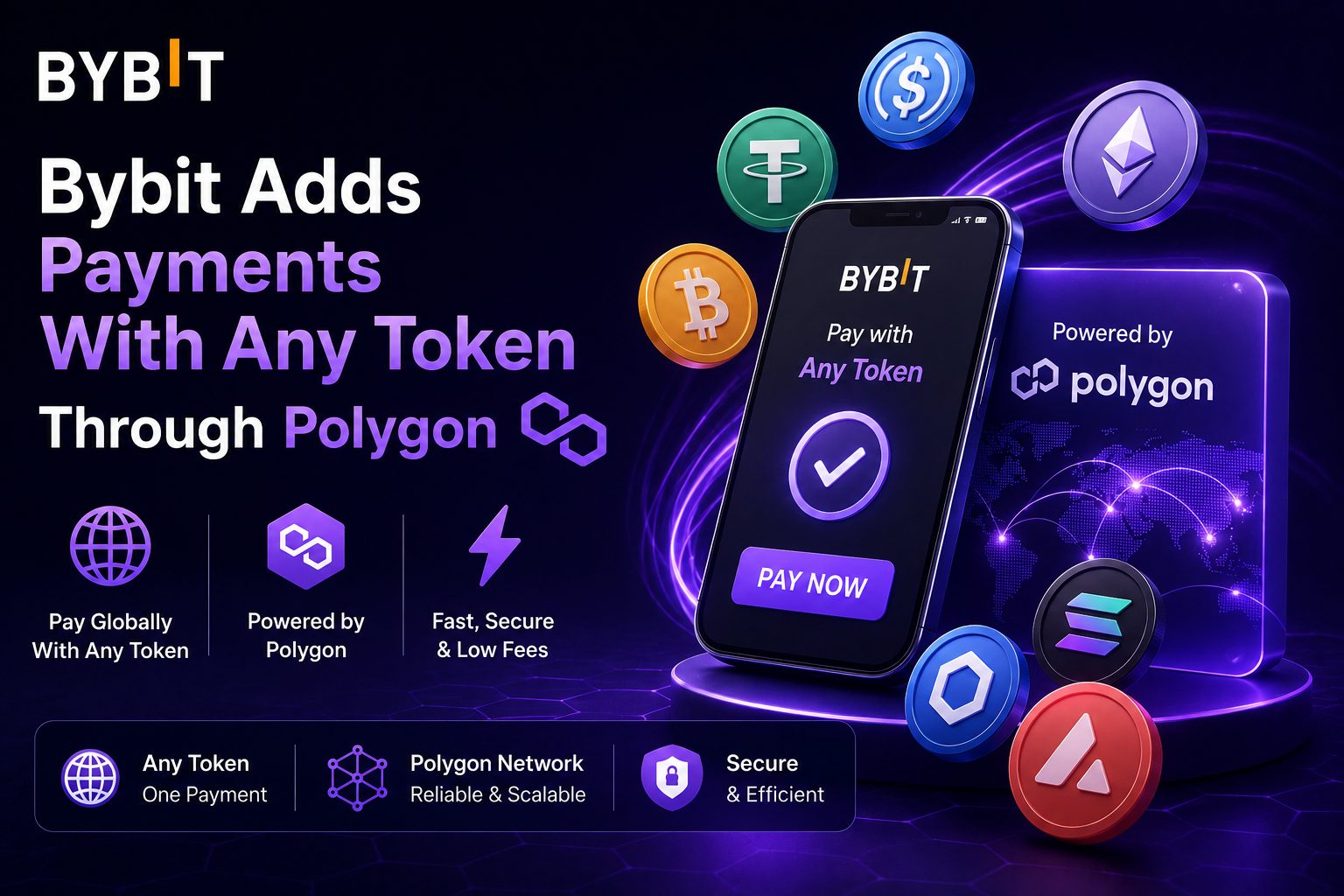
Polygon Foundation has announced the launch of Polygon OMS on Bybit. The new integration is designed to simplify payments within the exchange ecosystem and allow users to make purchases using different tokens across multiple blockchain networks.
According to Polygon, OMS is already being used in the UQUID mini-app on Bybit. This gives users access to a shopping interface where they can browse products, pay for orders, and complete purchases within a single streamlined process.
The main idea behind the new systеm is to reduce the number of steps required to make a payment. Instead of manually converting an asset into a specific cryptocurrency or transferring funds between networks, users can pay with an available token while Polygon infrastructure handles the rest of the payment process.
Polygon OMS Simplifies Payments on Bybit
Polygon OMS is designed to create a more universal payment layer for cryptocurrency commerce. The systеm brings different tokens and blockchain networks into a single user experience, reducing the need to manually manage transaction routes and asset compatibility.
For Bybit users, this means a simpler purchasing process through mini-apps connected to the platform. In the future, such infrastructure could enable users to spend a wide variety of digital assets without having to convert them into a specific payment token beforehand.
This approach is particularly important for mass cryptocurrency adoption. One of the main challenges of Web3 payments is fragmentation across different networks, tokens, and technical standards. A user may hold assets on one blockchain while a merchant accepts payments on another, creating additional steps and making the process more complicated.
OMS infrastructure aims to hide much of this technical complexity from the end user and make cryptocurrency payments feel more like traditional online shopping.
UQUID Becomes a Shopping Gateway Inside Bybit
One of the first use cases for Polygon OMS is the UQUID mini-app within Bybit. It allows users to interact with shopping services directly through the platform and complete the entire purchase process within a single interface.
Users can browse available products or services, choose what they need, and pay with cryptocurrency. Polygon OMS acts as the infrastructure layer that helps organize transactions between different digital assets and blockchain networks.
As a result, Bybit gains an additional tool for transforming users’ crypto balances from assets used mainly for trading into instruments that can also be used for everyday payments.
This reflects a broader trend among cryptocurrency platforms seeking to expand the use of digital assets beyond trading and investment.
Why Support for Different Tokens Matters
Cryptocurrency users often hold funds across multiple assets. These may inсlude stablecoins, tokens from different blockchains, DeFi assets, and other digital currencies.
Under a traditional payment model, users often have to first exchange an asset into a token supported by the merchant and then transfer it to the required network. This process may involve additional fees, delays, and several separate transactions.
The model being developed through Polygon OMS aims to reduce the number of intermediate steps. If the systеm can automatically identify the user’s available asset and determine the required payment route, the purchasing process becomes significantly easier.
For users, this lowers the technical barrier. For merchants, it may expand the potential customer base because they do not need to limit payments to a single cryptocurrency or blockchain network.
Multichain Payments Are Becoming an Important Part of Web3
As the cryptocurrency market develops, users increasingly interact with multiple blockchains at the same time. Assets may be held on Ethereum, Polygon, Arbitrum, Base, Solana, and other networks.
This multichain environment expands the possibilities of the market, but it also makes the user experience more complicated. Moving funds between networks often requires bridges, decentralized exchanges, or centralized trading platforms.
Next-generation payment solutions aim to automate these processes. Instead of forcing users to manually sеlect a network, swap assets, and send transactions, the systеm can handle the required operations automatically.
This is why infrastructure projects are increasingly working on mechanisms that abstract blockchain complexity away from the end user.
Polygon Continues to Develop Payment Infrastructure
Polygon, previously known as Matic Network, began as an Ethereum scaling solution and has gradually evolved into a broader blockchain infrastructure ecosystem.
One of the project’s key areas remains the development of technologies that allow developers to build scalable applications and process large numbers of transactions at relatively low cost.
The Polygon ecosystem includes tools for application development, payments, DeFi, NFTs, gaming, and tokenized assets.
In recent years, the project has also placed significant emphasis on payment use cases and interoperability between networks, as these areas are increasingly viewed as important foundations for broader blockchain adoption.
Low Fees Are Essential for Everyday Payments
Transaction cost and speed are especially important when cryptocurrencies are used for everyday purchases. If the transaction fee is comparable to the cost of the product itself, using blockchain becomes economically impractical.
Polygon was originally developed as infrastructure designed to reduce transaction costs compared with the Ethereum mainnet while increasing throughput.
This is one reason the network is widely used by applications that require a large number of relatively small transactions.
Payments are one of the clearest examples of such a use case because both buyers and merchants need fast settlement with minimal additional costs.
POL Plays a Key Role in the Polygon Ecosystem
An important component of the Polygon ecosystem is the POL token. It is used within the network’s economic model and is connected to security mechanisms, validator participation, and the operation of different infrastructure components.
Polygon uses a Proof of Stake model in which validators participate in securing the network and stake tokens as economic collateral.
This mechanism encourages participants to behave honestly because violations of network rules can result in financial penalties.
In addition to its infrastructure role, POL is connected to different applications within the ecosystem, including DeFi, payment solutions, and tokenized assets.
Polygon Is Widely Used in DeFi
The Polygon network has long been one of the major environments for decentralized finance. It hosts applications for lending, borrowing, token swaps, liquidity provision, and other financial services.
One of the network’s main advantages is relatively low transaction costs, allowing users to perform operations with lower expenses.
This is particularly important for smaller transactions, where high fees on a base-layer blockchain could make interaction with a DeFi application economically inefficient.
The development of payment infrastructure may be a natural continuation of this strategy as financial applications and commercial payments increasingly begin to overlap.
Tokenized Assets Are Becoming Another Area of Growth
Another important area for Polygon is the tokenized asset market. Blockchain technology allows different types of assets to be represented digitally and transferred directly within a network.
These may inсlude financial instruments, ownership rights, digital goods, or other assets represented in tokenized form.
For such an economy to function effectively, payment infrastructure is needed that allows users to easily transact with different digital assets.
If users can pay for products or services directly with tokens they already hold in their wallets, the practical utility of those assets increases significantly.
Bybit Expands Crypto Use Beyond Trading
For Bybit, the integration of Polygon OMS may provide another way to expand the platform beyond traditional cryptocurrency trading.
Major centralized exchanges are gradually evolving into broader crypto platforms that offer not only spot and derivatives trading, but also payments, wallets, Web3 services, investment products, and third-party applications.
The UQUID mini-app and Polygon OMS integration fit into this trend by allowing users to spend cryptocurrency assets directly on goods and services.
For users, this can shorten the path between holding a digital asset and using it in the real economy.
Simplifying the Interface Could Accelerate Mass Adoption
Despite the continued development of the blockchain industry, many cryptocurrency operations remain complicated for mainstream users. People often need to understand differences between networks, gas fees, bridge mechanics, and the characteristics of individual tokens.
Infrastructure solutions such as Polygon OMS aim to make most of these processes invisible to the end user.
In an ideal model, the buyer should only need to see the selected product, their available balance, and a payment button, while complex transaction routing happens at the infrastructure level.
This type of experience has long been standard in traditional e-commerce, and the cryptocurrency industry is gradually moving in the same direction.
Cryptocurrencies Are Gradually Becoming a Payment Tool
For many years, digital assets were primarily viewed as investment or speculative instruments. However, the development of stablecoins, low-cost blockchain networks, and new payment infrastructure is gradually expanding their practical use.
Users are increasingly gaining the ability to pay for products, services, subscriptions, and digital goods directly with cryptocurrency.
However, simplicity remains one of the key conditions for mass adoption. If paying with cryptocurrency requires more steps than using a bank card, a large share of users will continue choosing traditional payment methods.
That is why the ability to use different tokens without manually performing swaps and cross-network transfers could become an important step in the development of cryptocurrency commerce.
Polygon and Bybit Are Betting on Universal Web3 Payments
The launch of Polygon OMS on Bybit demonstrates how cryptocurrency platforms are gradually moving away from isolated blockchain environments toward a more universal model for interacting with digital assets.
For users, it becomes less important which exact token or blockchain their funds are stored on. What matters more is the ability to quickly use an available balance to pay for a desired product or service.
For Polygon, this creates an additional use case for its infrastructure, while for Bybit it offers an opportunity to provide users with a wider range of services within a single platform.
If such solutions continue to develop, cryptocurrency payments could become much closer to traditional digital payment systems in terms of ease of use.
In the longer term, infrastructure capable of automatically working with different tokens and blockchains could become one of the key components of mainstream Web3 commerce, where users can pay with digital assets almost as easily as they currently use a bank card or mobile wallet.