



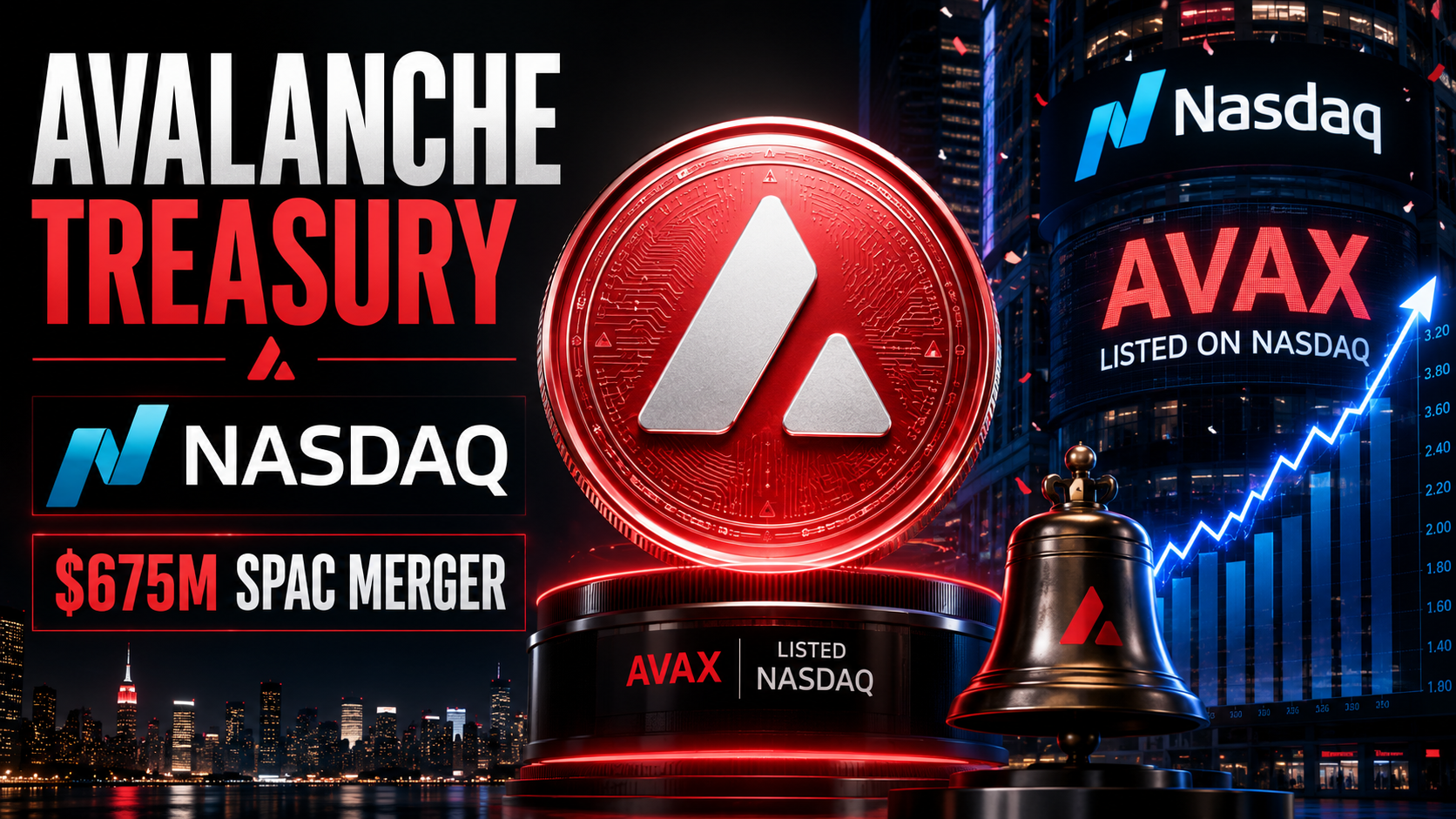
Avalanche Treasury Co., a digital asset management company focused on the development of the Avalanche ecosystem, has completed its merger with a special-purpose acquisition company and officially become a publicly traded business.
The transaction with the crypto-focused SPAC was valued at $675 million. Following the completion of the merger, Avalanche Treasury shares began trading on the Nasdaq stock exchange under the ticker AVAT.
The company has become one of the latest publicly traded vehicles offering investors exposure to the Avalanche ecosystem and the AVAX token through the traditional stock market.
TL;DR
- Avalanche Treasury began trading on Nasdaq under the ticker AVAT after completing a SPAC merger valued at $675 million.
- The company’s shares fell by more than 38% during their first trading session, closing at approximately $1.85.
- The company intends to use the raised capital to purchase AVAX, invest in Avalanche infrastructure, support validators, and develop partnerships.
- Avalanche Treasury’s long-term objective is to build an AVAX portfolio worth more than $1 billion.
Avalanche Treasury Enters the Public Market
Avalanche Treasury Co. officially became a public company after completing its combination with Mountain Lake Acquisition Corp., a special-purpose acquisition company created to carry out mergers and bring private businesses to the stock market.
Shares of the combined company began trading on Nasdaq under the AVAT ticker. This gives traditional investors an opportunity to invest in a business whose strategy is directly connected to the development of Avalanche and the accumulation of digital assets within its ecosystem.
The SPAC model allows a private company to enter the stock market by merging with an already listed public entity. This structure is generally viewed as an alternative to a conventional initial public offering.
For Avalanche Treasury, the Nasdaq listing is intended to serve not only as a way to raise capital, but also as a tool for building an institutional presence within the Avalanche ecosystem.
The company plans to support the development of blockchain infrastructure, invest in projects across the network, and expand its own AVAX reserves.
AVAT Becomes a Publicly Traded Vehicle for Exposure to Avalanche
Avalanche Treasury’s primary objective is to provide investors with structured exposure to the Avalanche ecosystem through publicly traded shares.
Instead of purchasing and storing cryptocurrency directly, investors can gain indirect exposure to AVAX and the growth of the network through AVAT shares.
The company links its strategy to a broader transition of financial and corporate infrastructure toward blockchain technology.
According to Avalanche Treasury’s management, publicly traded digital asset treasury companies could become a bridge between traditional capital markets and decentralized financial infrastructure.
CEO Bart Smith emphasized that Avalanche Treasury does not intend to limit its activities to speculative trading in the AVAX token.
According to Smith, the company plans to deploy capital deliberately to increase the long-term value of the Avalanche ecosystem.
This approach involves not only accumulating tokens, but also financing infrastructure, protocols, validators, and enterprise-focused solutions.
The Company’s Strategy Is Not Limited to Betting on the AVAX Price
Avalanche Treasury’s management positions the company as a strategic treasury vehicle rather than a fund whose only objective is to profit from an increase in the token’s price.
The company intends to use its capital to support ecosystem projects and develop Avalanche infrastructure.
Planned investment areas inсlude:
- purchasing AVAX for the company’s corporate reserve;
- investing in ecosystem protocols;
- developing validator infrastructure;
- supporting enterprise partnerships;
- financing blockchain-based products;
- expanding institutional use of Avalanche;
- participating in real-world asset tokenization projects.
Through this approach, Avalanche Treasury aims to create a long-term business model in which the company’s value depends not only on AVAX price movements, but also on the development of the broader network.
The company intends to act as an institutional bridge between traditional financial organizations and Avalanche’s decentralized infrastructure.
AVAT Shares Fall Sharply on Their First Trading Day
Despite the size of the transaction and support from major investors, Avalanche Treasury’s Nasdaq debut was accompanied by a significant decline in its share price.
According to the figures provided in the original report, AVAT shares lost approximately 38.1% and ended their first trading session at around $1.85.
The shares later recorded a modest recovery in after-hours trading, gaining approximately 2.7%.
This performance highlights the high volatility commonly associated with newly listed public companies, especially when their businesses are directly connected to the cryptocurrency market.
Investors may consider not only the company’s valuation, but also the condition of the Avalanche ecosystem, the AVAX price, the terms of the SPAC transaction, the financing structure, and the potential dilution of existing shareholders.
The sharp decline on the first day of trading also demonstrates that a large amount of raised capital and the participation of well-known investors do not guarantee a successful stock market debut.
The market may need time to assess Avalanche Treasury’s business model, the structure of its reserves, and its ability to generate long-term value.
AVAX Remains Under Pressure
As Avalanche Treasury entered the Nasdaq market, the AVAX token remained under pressure.
At the time of publication, AVAX was trading at approximately $6.60, following a decline of around 0.4% over the previous 24 hours.
The asset had lost approximately 33.7% during the previous month, reflecting broader market instability and the elevated volatility of Layer 1 blockchain tokens.
AVAX price movements are particularly important for Avalanche Treasury because a significant part of the company’s strategy is connected to purchasing and using the asset.
If the AVAX price declines, the value of the company’s treasury reserves may also decrease. Conversely, an increase in the token’s price could raise the value of its accumulated assets.
However, Avalanche Treasury’s business model involves a broader approach that includes investing in projects and network infrastructure rather than simply holding tokens passively.
The Transaction Was Announced in October 2025
The proposed combination between Avalanche Treasury and Mountain Lake Acquisition Corp. was initially announced in October 2025.
The total value of the transaction was approximately $675 million. The agreement included projected treasury financing of around $460 million.
In addition, the Avalanche Foundation was expected to provide an opportunity to acquire AVAX at a discount estimated at approximately $200 million.
This structure allowed Avalanche Treasury to gain initial access to a substantial amount of tokens and create a foundation for the further expansion of its treasury portfolio.
The company’s long-term objective is to acquire more than $1 billion worth of AVAX.
To reach this target, Avalanche Treasury may use the capital raised through the transaction, future share offerings, corporate agreements, and other financial instruments.
The Company Plans to Acquire More Than $1 Billion Worth of AVAX
One of the central elements of Avalanche Treasury’s strategy is the creation of a substantial AVAX reserve.
The company intends to gradually increase the value of its token holdings to more than $1 billion.
This model resembles the strategy used by public companies that allocate part of their corporate capital to accumulating a particular digital asset.
However, Avalanche Treasury plans to combine its treasury strategy with active participation in the development of the network.
Funds may be directed not only toward purchasing AVAX, but also toward protocols, infrastructure, validators, and partnership projects.
This approach is intended to allow the company to benefit both from a possible increase in the asset’s value and from the broader adoption of Avalanche.
Nevertheless, the model remains dependent on cryptocurrency market conditions, the regulatory environment, and the ecosystem’s ability to attract users, developers, and institutional capital.
Avalanche Treasury Is Backed by Major Investors
The project has received support from several well-known companies operating across the traditional financial and cryptocurrency sectors.
Avalanche Treasury’s investors and partners reportedly inсlude:
- Dragonfly Capital;
- ParaFi Capital;
- VanEck;
- FalconX;
- Galaxy Digital;
- Pantera Capital;
- Kraken.
The participation of these organizations strengthens Avalanche Treasury’s institutional positioning and may provide the company with improved access to capital, liquidity, infrastructure, and professional partnerships.
The management team also includes specialists with experience on Wall Street and within the cryptocurrency industry.
This combination of traditional finance and blockchain expertise is expected to help the company build relationships with institutional investors while also working with technology projects across the Avalanche ecosystem.
Avalanche Positions Itself as an Enterprise Blockchain Platform
Avalanche Treasury connects its long-term strategy to the expansion of enterprise and institutional use of Avalanche.
According to the company, the ecosystem has already attracted more than $1.02 billion in institutional capital.
In addition, more than $1.65 billion worth of real-world assets have reportedly been tokenized through Avalanche.
The network also supports more than 550 projects across decentralized finance, enterprise blockchain solutions, gaming products, tokenization, and payment infrastructure.
These figures are used to support the company’s argument that Avalanche is gradually developing into an enterprise-grade blockchain platform.
One of Avalanche’s distinguishing features is its ability to launch specialized blockchain networks adapted to the requirements of individual companies, financial organizations, or applications.
This approach may appeal to projects that require their own governance rules, dedicated validators, predictable performance, and tools for meeting regulatory requirements.
Real-World Asset Tokenization Becomes an Important Growth Area
Real-world asset tokenization is one of the most promising areas of development for Avalanche.
This involves moving ownership rights associated with traditional financial instruments, real estate, credit products, funds, and other assets onto blockchain infrastructure.
Tokenization may simplify settlements, increase transaction transparency, reduce the number of intermediaries, and expand access to certain investment products.
Avalanche Treasury plans to use this trend to develop institutional partnerships and finance infrastructure projects.
If companies and financial institutions continue adopting blockchain technology for issuing and managing assets, demand for Avalanche’s technological solutions could increase.
For Avalanche Treasury, this may create a growing number of investment opportunities within the ecosystem.
Public Cryptocurrency Treasury Companies Are Gaining Popularity
Avalanche Treasury is joining a growing category of publicly traded companies that build reserves in specific digital assets.
The most prominent treasury models were previously focused on Bitcoin. Over time, however, companies centered on Ethereum, Solana, Avalanche, and other ecosystems have also started to appear.
These structures offer traditional investors exposure to cryptocurrencies through regulated stock market platforms.
Investors do not need to create their own cryptocurrency wallets, manage private keys, or interact directly with digital asset exchanges.
At the same time, purchasing shares in a treasury company is different from directly owning the underlying token.
The share price may depend on the company’s capital structure, debt obligations, operating expenses, management quality, and overall market perception.
For this reason, AVAT shares may not fully track the price movements of AVAX.
Avalanche Treasury Joins the Growing AVAX Treasury Market
Avalanche Treasury is not the only publicly traded company focused on building AVAX reserves.
Similar initiatives reportedly inсlude AVAX One Technology Ltd., which is backed by prominent investor Anthony Scaramucci.
The emergence of several such companies suggests that institutional participants are beginning to view Avalanche as a separate investment ecosystem.
Public treasury companies allow investors to gain exposure to a Layer 1 blockchain through familiar stock market instruments.
Each company may use a different strategy, ranging from passive token accumulation to investments in validators, protocols, and enterprise infrastructure.
The growing number of AVAX-focused treasury companies could also increase institutional demand for the token, although the actual impact will depend on the scale of their purchases and broader market conditions.
Risks of the Treasury Model
Despite its potential advantages, the cryptocurrency treasury model involves several significant risks.
The value of the company’s assets may change sharply together with the price of AVAX. During an extended market decline, the value of its corporate reserves could fall substantially.
Additional risks inсlude:
- cryptocurrency market volatility;
- possible shareholder dilution through future offerings;
- dependence on continued access to capital;
- changes in digital asset regulation;
- operating expenses;
- token custody risks;
- technological risks associated with the Avalanche network;
- competition from other Layer 1 blockchains;
- a potential difference between the market value of the shares and the value of the company’s reserves.
Investors should assess not only the amount of AVAX held on the company’s balance sheet, but also its liabilities, transaction structure, management quality, and long-term investment strategy.
Why Avalanche Treasury’s Nasdaq Listing Matters
The appearance of AVAT on Nasdaq demonstrates that institutional interest in cryptocurrency treasury models is expanding beyond Bitcoin.
Investors are receiving new ways to allocate capital to individual blockchain ecosystems through publicly traded companies.
For Avalanche, the listing of a treasury-focused company on a major stock exchange may increase the ecosystem’s visibility among traditional financial institutions.
The company could also become a source of long-term capital for Avalanche projects, validators, and enterprise infrastructure.
At the same time, the decline in the share price during the first trading session highlights the market’s cautious attitude toward these models and the need for companies to demonstrate the sustainability of their businesses.
AVAT’s future performance will depend on how effectively the company uses the raised capital, increases the value of its reserves, and supports the development of the ecosystem.
Conclusion
Avalanche Treasury Co. became a publicly traded company after completing a $675 million SPAC transaction with Mountain Lake Acquisition Corp.
The shares began trading on Nasdaq under the ticker AVAT, but declined by more than 38% during their first trading session.
The company plans to use the raised capital to purchase AVAX, invest in protocols, develop validator infrastructure, and support enterprise partnerships.
Avalanche Treasury’s long-term objective is to build an AVAX reserve worth more than $1 billion.
The project is supported by major investors from the traditional financial and cryptocurrency sectors, including Dragonfly Capital, VanEck, Galaxy Digital, Pantera Capital, and Kraken.
Avalanche Treasury’s public listing reflects growing interest in publicly traded treasury companies focused on individual blockchain ecosystems.
However, the high volatility of both AVAT and AVAX demonstrates that these investment models remain risky and highly dependent on cryptocurrency market conditions.
This material is for informational purposes only and does not constitute investment advice.