



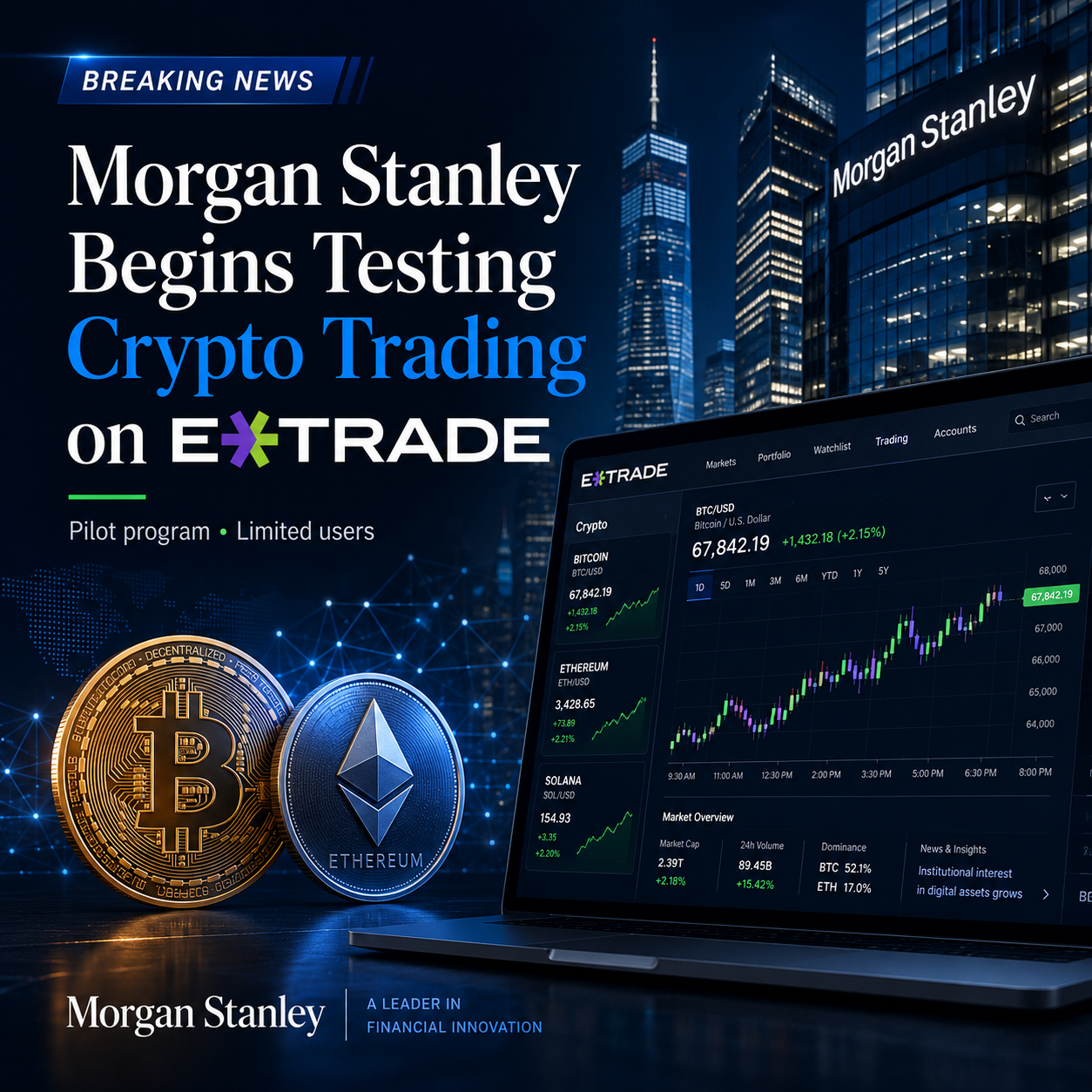
Later this year, the company plans to expand access to the broader E*Trade customer base, which includes approximately 8.6 million users. Initially, the platform will support trading for major digital assets including Bitcoin, Ethereum, and Solana.
Morgan Stanley Tests Crypto Trading on E*Trade
The launch of the pilot program signals that Morgan Stanley continues to strengthen its position in the digital asset market. Integrating cryptocurrency trading into E*Trade could become an important step toward attracting retail investors who want to access crypto markets through a familiar brokerage platform.
At launch, users will gain access to some of the most liquid and widely traded cryptocurrencies — BTC, ETH, and SOL. This selection appears strategic, as these assets remain among the most recognized and actively traded digital assets within the crypto industry.
0.5% Trading Fee as a Competitive Advantage
One of the key features of the pilot program is the 0.5% transaction fee. This pricing appears competitive compared to many retail crypto platforms and could increase pressure on other market participants.
For Morgan Stanley, this creates an opportunity to establish a stronger position within the cryptocurrency trading sector among traditional financial institutions. If the offering is eventually expanded across the full E*Trade user base, the bank could compete not only with crypto exchanges but also with brokerage platforms already integrating digital assets into their services.
Potential Impact on Industry Fees
Bloomberg ETF analyst Eric Balchunas stated that Morgan Stanley’s aggressive pricing strategy could intensify competition across the industry and contribute to further reductions in trading fees.
He compared the situation to the launch of spot Bitcoin ETFs, when issuers lowered expense ratios in order to attract capital inflows. Over time, competition among ETF providers resulted in lower costs across the sector.
According to Balchunas, a similar trend could emerge in the retail crypto trading market. If major financial firms begin competing primarily through pricing, transaction fees could eventually decline to near-zero levels.
Alternative Revenue Models
Even if commissions continue falling, trading platforms may shift toward alternative monetization strategies. One possible model is payment for order flow, where market makers or trading venues compensate brokers for routing client orders through their systems.
At the same time, Balchunas noted that ETFs will likely remain one of the preferred vehicles for crypto exposure in the near term, especially among institutional and more conservative investors seeking regulated investment products.
Traditional Finance Continues Expanding Into Crypto
Morgan Stanley’s pilot launch reflects a broader trend in which major financial institutions continue expanding their involvement in digital assets.
Morgan Stanley previously strengthened its crypto strategy through the launch of the MSBT spot Bitcoin ETF. The company is now testing direct cryptocurrency trading through E*Trade, potentially making digital assets more accessible to mainstream retail investors.
Other major financial firms are also expanding their crypto offerings. Charles Schwab has already launched spot Bitcoin and Ethereum trading, although with higher fees. Goldman Sachs, JPMorgan, BNY Mellon, and Citigroup continue developing services related to digital asset custody, trading, and blockchain infrastructure.
Why the Launch Matters
If Morgan Stanley successfully scales cryptocurrency trading across E*Trade, the move could increase competition between traditional brokers and crypto exchanges. For customers, this may ultimately result in lower fees, easier access to digital assets, and growing confidence in crypto markets from the traditional financial sector.
The addition of crypto trading inside large brokerage platforms could also influence how retail investors interact with digital assets. Instead of registering on standalone crypto exchanges, users may increasingly buy and sell cryptocurrencies within the same environment where they already trade stocks, ETFs, and other investment products.
Conclusion
Morgan Stanley has reportedly launched pilot cryptocurrency trading on E*Trade with a 0.5% transaction fee. During the initial phase, Bitcoin, Ethereum, and Solana are available, while broader access may later expand to millions of E*Trade clients.
The initiative could intensify competition within the retail crypto trading market and potentially trigger further reductions in industry trading fees. At the same time, it reinforces the ongoing trend of major financial institutions gradually integrating digital assets into their products and infrastructure.