



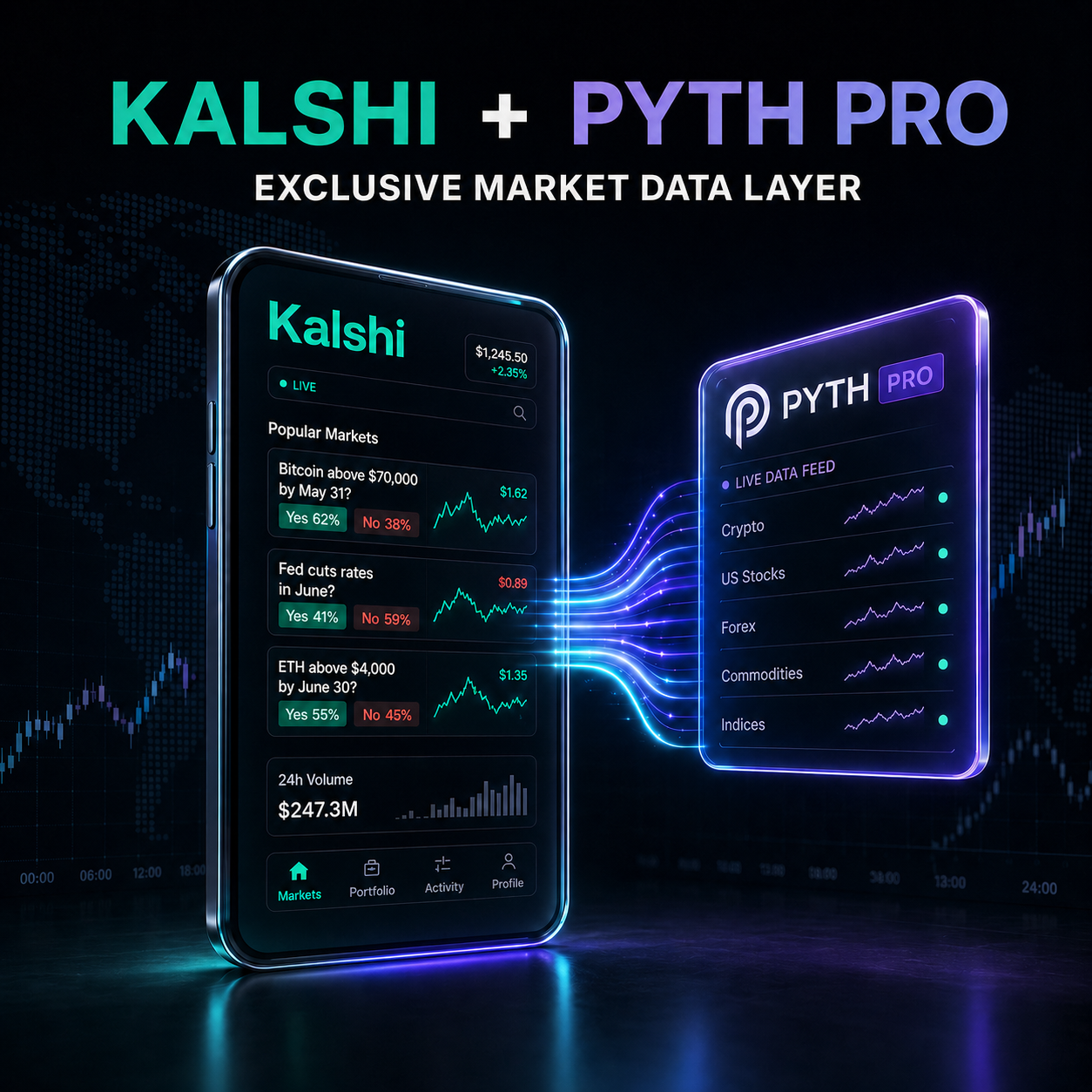
Pyth Network announced that Kalshi, the first prediction market regulated by the U.S. Commodity Futures Trading Commission CFTC, is using Pyth Pro as its exclusive data layer to support real-world asset RWA markets and the settlement of event contracts linked to commodities.
This partnership marks an important step in the development of prediction market infrastructure, as Kalshi gains access to institutional-grade market data that can be used for more transparent, accurate, and timely market resolution based on real asset prices.
Kalshi expands its commodity markets segment
Kalshi’s new commodities hub takes prediction markets to a more advanced level. The platform is creating a dedicated space for event contracts tied to some of the world’s most important physical markets.
At the initial launch stage, Kalshi covers a broad range of commodities, including gold, silver, Brent crude oil, natural gas, copper, corn, soybeans, and wheat. These assets play an important role in the global economy, which makes a reliable data layer critically important for the correct settlement of such markets.
As Kalshi continues to expand its commodities segment, the platform is expected to add new asset classes and increase the number of markets linked to global economic events, commodity indexes, and other instruments.
Why Kalshi is using Pyth Pro
Institutional-grade data
Pyth Pro provides institutional-grade market data directly from leading market participants. Unlike traditional data distribution models, Pyth aggregates prices directly from companies that actively trade the underlying assets.
This approach makes it possible to form a globally accessible real-time price suitable for 24/7 market resolution across different asset classes. For Kalshi, this is especially important because prediction markets require reliable data sources that can objectively determine event outcomes.
Solving the problems of traditional infrastructure
Pyth Pro is designed to address several problems in the legacy market data supply chain, including fragmentation, high costs, delays, and information gaps. The solution brings data together into a single distribution network, making it more transparent and accessible for institutional and crypto applications.
How Pyth’s data model works
Pyth’s proprietary data model is built around aggregating prices from professional liquidity providers, exchanges, market makers, and companies that directly participate in trading the underlying assets.
The collected data is transparently aggregated using cryptographic verification. In addition, the systеm is supported by staking and slashing mechanisms, which incentivize participants to provide accurate information and help maintain data quality.
The main idea behind this approach is to capture price discovery as close to the source as possible. This helps create a more reliable data systеm where accuracy and participation are backed by economic incentives.
Pyth partners and infrastructure development
To develop this new market data model, Pyth works with major participants in the financial and technology industries. Organizations and partners associated with the Pyth ecosystem inсlude Cboe, Jane Street, Revolut, and the U.S. Department of Commerce.
This cooperation is aimed at building a more open, accurate, and transparent market data infrastructure. Pyth seeks to offer an alternative to traditional data providers, which often operate through closed and expensive data distribution models.
For institutional clients, this may mean more convenient access to data across different markets. For blockchain applications, it provides the ability to use verified price feeds for DeFi, RWA, derivatives, prediction markets, and other financial products.
The scale of Pyth Pro coverage
Which markets Pyth Pro covers
Pyth Pro brings global coverage into a single distribution network. According to the project, the solution supports more than 2,000 data feeds across different asset classes.
- stocks;
- futures;
- ETFs;
- commodities;
- currency pairs;
- cryptocurrencies;
- fixed-income instruments.
Data speed and reliability
The data is updated with millisecond-level frequency, making Pyth Pro suitable for applications that require highly responsive price updates. The project also reports more than 99.9% uptime and 95% accuracy compared with NBBO.
In addition, new symbols are added every week, allowing Pyth Pro to gradually expand its coverage and adapt to the needs of institutional clients, DeFi protocols, and markets connected to real-world assets.
The role of Pyth Pro for RWA and prediction markets
The integration of Pyth Pro with Kalshi is especially important in the context of growing interest in RWA — real-world assets being brought into digital and blockchain infrastructure. For such markets, an accurate, transparent, and verifiable data source is essential.
If a prediction market is linked to the price of gold, oil, gas, or agricultural commodities, the final result must be determined using reliable market data. Errors, delays, or price manipulation can affect contract settlement and participant trust.
By using Pyth Pro, Kalshi can build a more resilient market resolution model, where data comes from active trading participants and passes through an aggregation and verification infrastructure.
The first Pyth Pro user is already live
In addition to Kalshi, Pyth Pro is already being used in the DeFi ecosystem. The first user of the solution was Aftermath Finance, a DEX and LSD protocol on the Sui blockchain.
Aftermath Finance integrated Pyth Pro to provide faster and more accurate pricing for its products. This shows that Pyth Pro infrastructure can be applied not only in regulated prediction markets but also in decentralized finance protocols.
What is Pyth Network?
A decentralized oracle for financial data
Pyth Network is a decentralized oracle focused on providing financial market data for blockchain applications, DeFi protocols, and institutional solutions.
The network receives data from more than 90 third-party publishers, including major exchanges, market makers, and professional financial market participants. This approach allows Pyth to create price feeds for a wide range of assets and use them across different blockchain ecosystems.
Why oracles are important for the crypto market
Oracles play an important role in crypto infrastructure because they connect blockchain applications with external market data. Without reliable oracles, many DeFi products, derivatives, lending protocols, and prediction markets cannot correctly work with real asset prices.
PYTH token performance
Following the news, the PYTH token showed a decline of about 2% over the past 24 hours and traded near $0.04591 per coin.
Despite the short-term market movement, the integration with Kalshi can be seen as an important infrastructure milestone for Pyth Network. The use of Pyth Pro by a regulated prediction market highlights the growing role of verifiable data across RWA, commodity markets, DeFi, and institutional crypto infrastructure.
Conclusion
The partnership between Kalshi and Pyth Pro shows that prediction markets are gradually moving toward a more complex and institutional model. For the settlement of contracts linked to commodities and real-world assets, platforms need more than simple price access — they need reliable data infrastructure capable of providing transparency, speed, and accuracy.
Pyth Pro aims to occupy this niche by offering a unified market data network with broad coverage, high-frequency updates, and verification mechanisms. For Kalshi, this opens the door to further development of commodity prediction markets, while for Pyth Network it strengthens its position in institutional data and RWA infrastructure.