



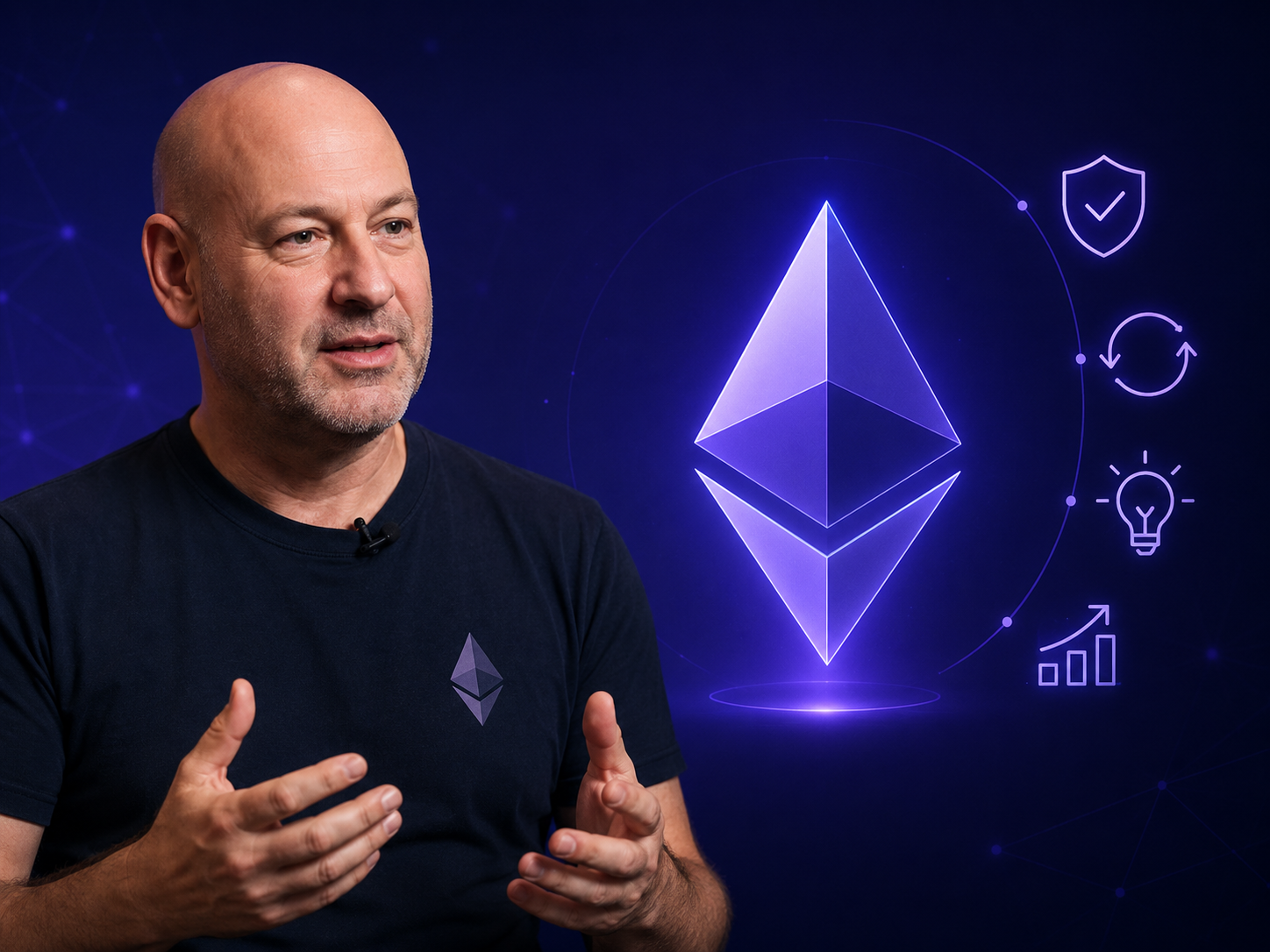
Ethereum co-founder Joe Lubin commented on the growing criticism of the Ethereum Foundation and said that the recent budget cuts, staff layoffs, and leadership changes should not be viewed as signs of instability. According to him, what is happening looks more like a natural structural transformation of the organization, which needs to define its role within the Ethereum ecosystem more clearly.
Lubin believes that the Ethereum Foundation should focus on its core mission: supporting the base protocol, its security, technical resilience, and neutrality. At the same time, commercial development, institutional adoption, ecosystem promotion, and user-facing products can be developed more actively by other organizations.
According to Lubin, this model better reflects the decentralized nature of Ethereum. Instead of trying to control all areas at once, the ecosystem should distribute responsibility among several independent participants.
TL;DR
- Ethereum co-founder Joe Lubin disagreed with criticism of the Ethereum Foundation amid budget cuts, restructuring, and leadership changes.
- He believes the foundation should focus on the protocol, technical neutrality, and Ethereum’s long-term resilience.
- Commercial development, institutional adoption, and ecosystem growth, in his view, should be handled by other market participants.
- Lubin is confident that the changes at the foundation are not a sign of crisis, but part of Ethereum’s transition toward a more distributed development model.
Lubin Defends the Ethereum Foundation’s Direction
Joe Lubin defended the Ethereum Foundation amid active discussions within the community. In recent weeks, some market participants have expressed dissatisfaction with spending cuts, personnel changes, and the revision of the foundation’s structure.
Lubin, who was one of Ethereum’s creators but currently does not hold an official role at the Ethereum Foundation, believes these developments should be seen as an attempt to clarify the foundation’s functions. In his view, the organization should not turn into a commercial center or take responsibility for every aspect of ecosystem growth.
He emphasized that the main value of the Ethereum Foundation lies in its neutrality. The foundation should remain an organization that works in the interests of the protocol, not in favor of individual companies, business lines, or commercial projects.
Lubin noted that mixing business interests with developers’ work can create the risk of conflicts of interest. That is why, in his opinion, the Ethereum Foundation should remain as independent as possible and focused on the technological foundation of the network.
The Ethereum Foundation Should Narrow Its Focus
According to Lubin, the Ethereum Foundation needs to define the boundaries of its responsibility more clearly. Instead of trying to work on every direction at once, the foundation should concentrate on development, security, resilience, and the neutrality of Ethereum’s base protocol.
Ecosystem expansion, marketing, institutional outreach, commercial products, and user adoption can be developed through other organizations. Lubin says this approach better matches the idea of decentralization.
He described the current restructuring as a process of cleaning up organizational boundaries. From his perspective, the foundation is not falling apart. On the contrary, it is trying to remove unnecessary overlap between protocol development and business activity.
This is important for trust in Ethereum as neutral infrastructure. If the organization responsible for the base protocol becomes too deeply involved in commercial areas, market participants may start questioning its impartiality.
Criticism of the Ethereum Foundation Has Intensified Amid Competition
Lubin’s comments came amid lively debate within the Ethereum community. Some participants believe that the Ethereum Foundation acts too cautiously, adapts too slowly to market changes, and is losing ground to competitors in the battle for developers, investors, and users.
Critics have also pointed to leadership changes and budget cuts as possible signs of internal problems. In their view, Ethereum should compete more actively with other blockchain ecosystems, especially amid the growth of alternative L1 and L2 networks.
However, Lubin disagrees with this interpretation. He believes many of the complaints come from a misunderstanding of the Ethereum Foundation’s role. The foundation does not have to be the main commercial driver of the entire ecosystem. Its task is to ensure the reliability, security, and neutrality of the infrastructure on which other projects can build.
According to Lubin, if the Ethereum Foundation tries to be responsible for the protocol, marketing, institutional sales, commercial products, and application development at the same time, this could weaken its core function: protecting Ethereum’s neutral base layer.
Ethereum Remains One of the Largest Blockchain Networks
Despite the criticism, Ethereum remains one of the largest blockchain networks in the world. A broad ecosystem has formed around it, including developers, DeFi protocols, L2 solutions, stablecoins, NFT projects, DAOs, and enterprise applications.
The network processes millions of transactions every day, while Ethereum’s infrastructure is used as the foundation for many decentralized applications. This highlights the scale of the systеm, whose resilience depends not only on the Ethereum Foundation but also on a wide community of participants.
Lubin believes that this scale requires a more distributed governance model. Ethereum should not depend on a single foundation or one central structure. Instead, the ecosystem should rely on several major development centers, each responsible for its own areas.
A More Distributed Development Model for Ethereum
Lubin suggested that, in the future, Ethereum will be supported by several key organizations that will act as important nodes of governance and ecosystem development. Some organizations may focus on protocol development, others on institutional adoption, and others on commercial products, infrastructure, or user services.
In his view, this model better reflects Ethereum’s philosophy. Instead of a vertically integrated systеm where everything is controlled by one center, the ecosystem should develop through a network of independent but interconnected participants.
Lubin believes that a distributed structure makes Ethereum more resilient in the long term. If different areas are developed by different organizations, this reduces the risks of concentrated influence and helps preserve the neutrality of the protocol.
This approach may also increase the ecosystem’s flexibility. Commercial companies will be able to launch products and work with clients faster, while the Ethereum Foundation can maintain its focus on the technical base and long-term security of the network.
Ethereum Is No Longer at the Center of All Attention
At the same time, Lubin acknowledged that the crypto industry as a whole no longer occupies the same place in the spotlight as it did several years ago. Previously, crypto was seen as one of the leading technology narratives, but now a significant portion of capital, media attention, and investor interest has shifted toward artificial intelligence.
According to Lubin, AI is currently the dominant direction for technology companies, venture funds, and global markets. This also affects how the crypto industry is perceived: Ethereum and other blockchain projects no longer receive the same level of attention they did during previous market cycles.
Nevertheless, Lubin does not see this as a sign of Ethereum’s weakness. In his view, the network’s infrastructure continues to develop, and new use cases may help Ethereum regain stronger positions during the next stage of technological growth.
Agentic Commerce May Become a New Driver for Ethereum
One of the most promising areas, according to Lubin, is agentic commerce. This refers to a scenario in which autonomous artificial intelligence systems can directly interact with blockchain networks, conduct transactions, manage digital assets, and participate in economic activity.
In this model, AI agents could use blockchain as settlement and coordination infrastructure. They could pay for services, enter into agreements, manage digital resources, interact with smart contracts, and perform tasks without constant human involvement.
Lubin believes that a hybrid human-machine economy may emerge in the future, where people and autonomous systems use blockchain infrastructure for payments, agreement execution, and financial flow management.
Ethereum, with its mature smart contract network, large developer base, and wide range of infrastructure solutions, could become one of the key platforms for these processes.
Institutional Adoption Remains an Important Growth Factor
In addition to agentic commerce, Lubin highlighted the growing institutional adoption of Ethereum-based solutions. Financial institutions, infrastructure companies, and corporate players are increasingly exploring blockchain opportunities for asset tokenization, settlements, liquidity management, and financial process automation.
Ethereum has already become one of the main platforms for tokenized assets, stablecoins, and decentralized finance applications. As traditional financial institutions integrate blockchain technologies more deeply, Ethereum’s role as a base layer for applications may strengthen.
Lubin believes that Ethereum’s long-term potential is connected not only to retail usage but also to broader infrastructure adoption in institutional environments. This could become one of the factors behind the next wave of growth.
Why Changes at the Ethereum Foundation Matter for the Network’s Future
According to Lubin, narrowing the Ethereum Foundation’s focus is not a forced retreat, but a necessary step for the next stage of the network’s development. The larger the ecosystem becomes, the more important it is to divide functions among different participants.
The foundation should continue to be responsible for fundamental elements: protocol security, technical resilience, neutrality, and support for base-layer developers. At the same time, other organizations can work on user growth, business partnerships, institutional products, and commercial solutions.
This approach allows Ethereum to remain a decentralized ecosystem, where different participants develop different areas without turning the Ethereum Foundation into a single decision-making center.
Lubin believes that this separation of roles will allow Ethereum to preserve trust as a neutral protocol while continuing to develop as a technological foundation for new applications.
Conclusion
Joe Lubin believes that the recent changes at the Ethereum Foundation do not indicate a crisis, but reflect a mature restructuring of the foundation’s role. In his view, the organization should focus on what matters most: supporting a neutral, secure, and resilient Ethereum protocol.
Commercialization, institutional adoption, marketing, and ecosystem expansion should be developed through other structures. According to Lubin, this model better reflects Ethereum’s decentralized nature and reduces the risk of conflicts of interest.
Despite reduced attention to the crypto market amid the artificial intelligence boom, Lubin believes Ethereum retains strong long-term positions. New directions, including agentic commerce, institutional adoption, and the use of blockchain by AI systems, may become important drivers of the network’s future development.
In this context, the restructuring of the Ethereum Foundation looks less like a sign of weakness and more like an attempt to prepare the ecosystem for the next stage of growth, where the base protocol must remain neutral, secure, and open to all market participants.