



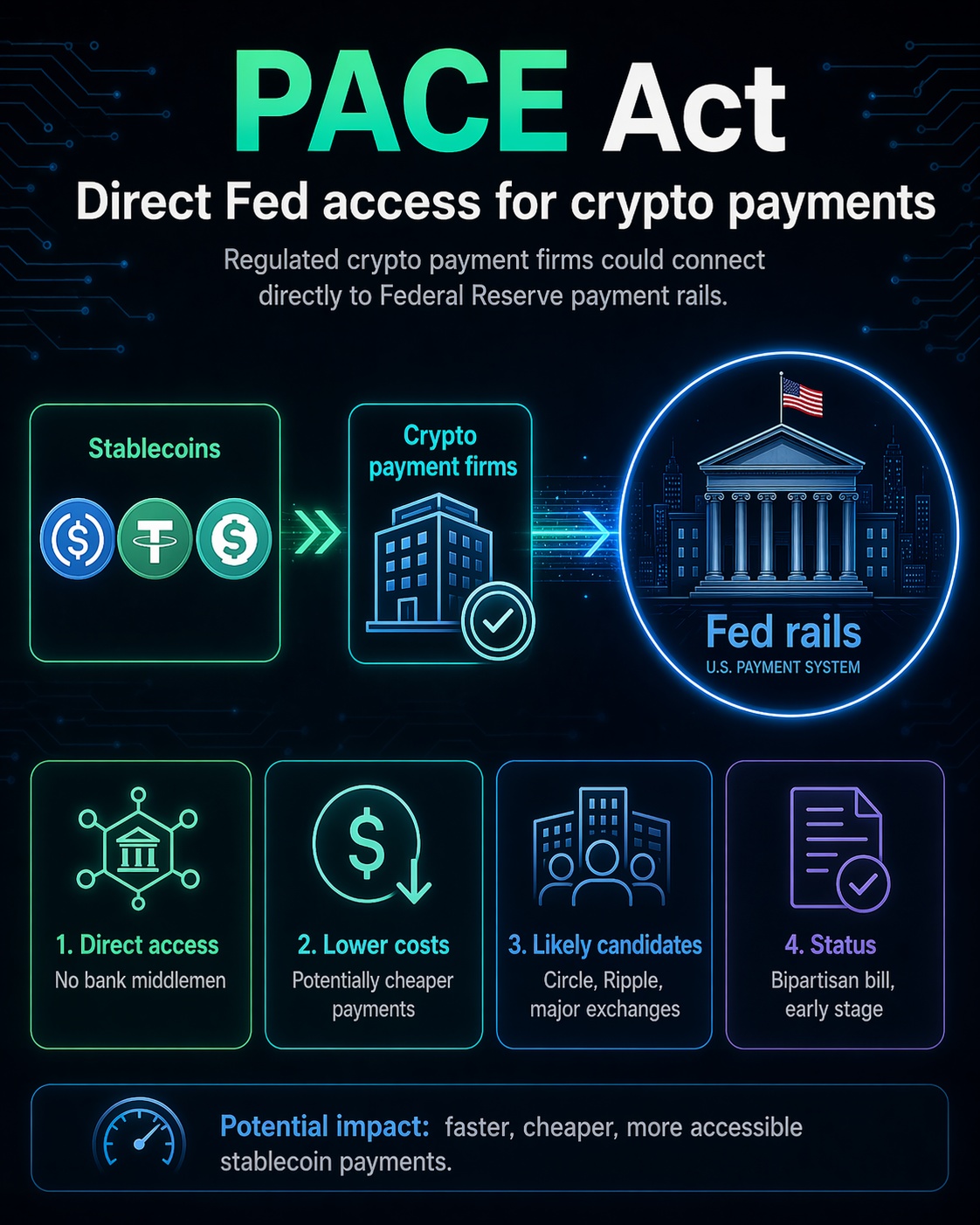
Stablecoin issuers already move billions of dollars every day, yet these transactions still do not pass directly through the U.S. Federal Reserve’s payment infrastructure. Instead, such companies are forced to operate through intermediary banks, which increases settlement costs, adds extra fees, and makes the process itself less efficient.
This is exactly the problem that the new bipartisan bill known as PACE — the Payments Access and Consumer Efficiency Act — is designed to address. The proposal aims to change the current model of access to U.S. payment rails and allow qualified nonbank payment companies to interact directly with certain Federal Reserve systems rather than only through banking partners.
Why the PACE bill is considered important
In essence, the proposal is an attempt to make regulated crypto payment and fintech companies more fully integrated participants in U.S. payment infrastructure. If the initiative is adopted, approved companies could gain access to key Federal Reserve payment systems under terms similar to those already available to banks.
For the market, this would mean more than just a technical adjustment. Direct access to payment infrastructure could reduce costs, accelerate settlements, and lessen dependence on bank intermediaries, which currently control entry into the federal payment systеm.
At present, banks act as the mandatory link between crypto companies and U.S. payment rails. As a result, stablecoin issuers and other payment players often face additional costs, which are then passed on to customers or users of the infrastructure.
What direct access to Federal Reserve payment rails would change
Supporters of the initiative emphasize that direct access to Federal Reserve payment systems is not only about lowering fees. It is also about speed, availability, and competitiveness. If such companies are able to settle directly, payments could become faster and dependence on outside participants could decline.
In practical terms, this means the ability to execute near real-time settlements, create more flexible payment products, and build services around their own infrastructure logic rather than on the terms set by banking intermediaries. For users, this could mean cheaper and faster transfers, while for the companies themselves, it could open up new opportunities for scaling.
In this sense, the PACE bill fits into the broader trend of modernizing U.S. financial infrastructure, where digital payments, stablecoins, and new settlement formats are gradually becoming part of the wider payments framework.
Who would be able to qualify for such access
At the same time, the bill does not envision open access for everyone. Its authors deliberately built fairly narrow eligibility criteria into the text. The idea is to provide this opportunity only to companies that already operate on a national scale, are regulated, and are capable of meeting strict supervisory requirements.
One of the key requirements is the presence of money transmitter licenses in at least 40 states. That threshold automatically filters out smaller startups and makes the pool of potential participants fairly limited.
In practice, this means that the companies most likely to qualify are large regulated crypto payment firms, stablecoin issuers, and major crypto platforms already active in the U.S. market. However, even for them, access would not be automatic. Scale alone would not guarantee entry into Federal Reserve infrastructure — full compliance with all regulatory requirements and separate approval would still be necessary.
Why access would not be unconditional
Even if a company meets the basic eligibility criteria, that does not mean it would immediately receive direct access to U.S. payment systems. The bill preserves strict standards related to customer fund custody, reserves, risk management, segregation of assets, and overall financial resilience.
In other words, PACE does not eliminate regulation. Rather, it creates a new framework in which nonbank payment companies would be able to operate more directly while still remaining under tight supervision. This approach is meant to reduce concerns about allowing insufficiently resilient participants into sensitive financial infrastructure.
For supporters of the bill, this is a key argument: the proposal is not about deregulation, but about leveling access rules for companies that already perform payment functions in practice and are capable of meeting standards comparable to those applied to banks.
Who supports the bill
PACE is already receiving noticeable support from the crypto industry and the fintech sector. For digital payment companies, such legislation looks like a logical step toward greater independence and lower infrastructure costs. At the industry level, it is being presented as a way to make the U.S. payment systеm more open to innovation and less dependent on an outdated intermediary-based model.
For participants in the crypto market, this is especially important in the context of stablecoins, which are increasingly being used not only within the crypto industry, but also as tools for settlement, liquidity management, and cross-border transfers. If such players gain the ability to work directly with the payment systеm, it could strengthen their position within the traditional financial environment.
In addition, the bill’s bipartisan sponsorship itself increases interest in the initiative and makes it more visible among other proposals related to digital asset regulation.
Who opposes it
At the same time, resistance from the banking sector is understandably growing. Banks and banking lobby groups have traditionally approached with caution any initiative that reduces their role as intermediaries between the market and federal payment infrastructure.
If crypto payment companies and large stablecoin issuers gain the ability to connect directly to payment rails, this could mean weaker bank control over an important part of money flows. That makes the issue not only a matter of technological reform, but also one of shifting influence within the financial systеm.
This is why a clear line of conflict is already forming around the bill between the fintech and crypto sectors on one side and the traditional banking lobby on the other. For banks, the question is tied not only to safety and regulation, but also to preserving their own infrastructure role.
Why PACE matters for the stablecoin market
For the stablecoin market, the bill could prove especially significant. Today, such companies already process enormous transaction volumes, yet they are still forced to fit into the traditional financial systеm through indirect mechanisms. That makes the market less efficient than it could be under a model of direct access to payment systems.
If PACE is adopted, stablecoins could become even more deeply integrated into U.S. payment infrastructure. This could make settlements faster, lower the cost of transfers, and at the same time bring digital dollar instruments closer to becoming a full-fledged element of the modern financial systеm.
In a broader sense, it could also change how stablecoins are perceived by businesses, users, and regulators. Rather than remaining a tool that exists alongside the traditional systеm, they could become part of that systеm itself.
How the bill fits into broader regulatory reform
PACE is not being viewed in isolation, but as part of a wider wave of legislative initiatives around digital assets and stablecoins. In this broader context, other U.S. bills are already being discussed that seek to clarify the legal status of digital assets and regulate the issuance, redemption, and oversight of stablecoins.
This is why PACE is seen as a logical complement to the overall regulatory framework. If one set of laws defines how stablecoins should be regulated as financial products, PACE addresses a different question: how participants in that market would be able to connect to the country’s core payment infrastructure.
In other words, the issue is no longer simply about recognizing digital assets as a phenomenon. It is about trying to integrate them into the world’s largest economy at the infrastructure level.
What are the chances of passage
Even so, it is important to understand that at this stage the bill has only been introduced and still faces a long legislative path. Even bipartisan backing and industry interest do not guarantee quick adoption.
Political disputes, pressure from the banking sector, debates over consumer risks, and additional regulatory demands may still arise along the way. That is why it would be premature to speak of imminent approval.
However, the very fact that such an initiative has appeared already shows that discussion about the role of crypto payment companies in the U.S. financial systеm is moving to a new level. This is no longer a peripheral topic, but an effort to reshape the very structure of access to payment infrastructure.
Conclusion
The PACE Act could become an important milestone in the development of the U.S. digital payments market. It proposes giving regulated crypto payment companies a chance to obtain direct access to Federal Reserve payment rails, reduce dependence on bank intermediaries, and improve settlement efficiency.
For users, this could potentially mean cheaper and faster transfers. For stablecoin issuers and major crypto companies, it could mean the ability to work with U.S. financial infrastructure on more equal terms. And for the industry as a whole, it could mark another step toward turning digital assets and stablecoins from an external add-on into a core part of the U.S. payments architecture.