



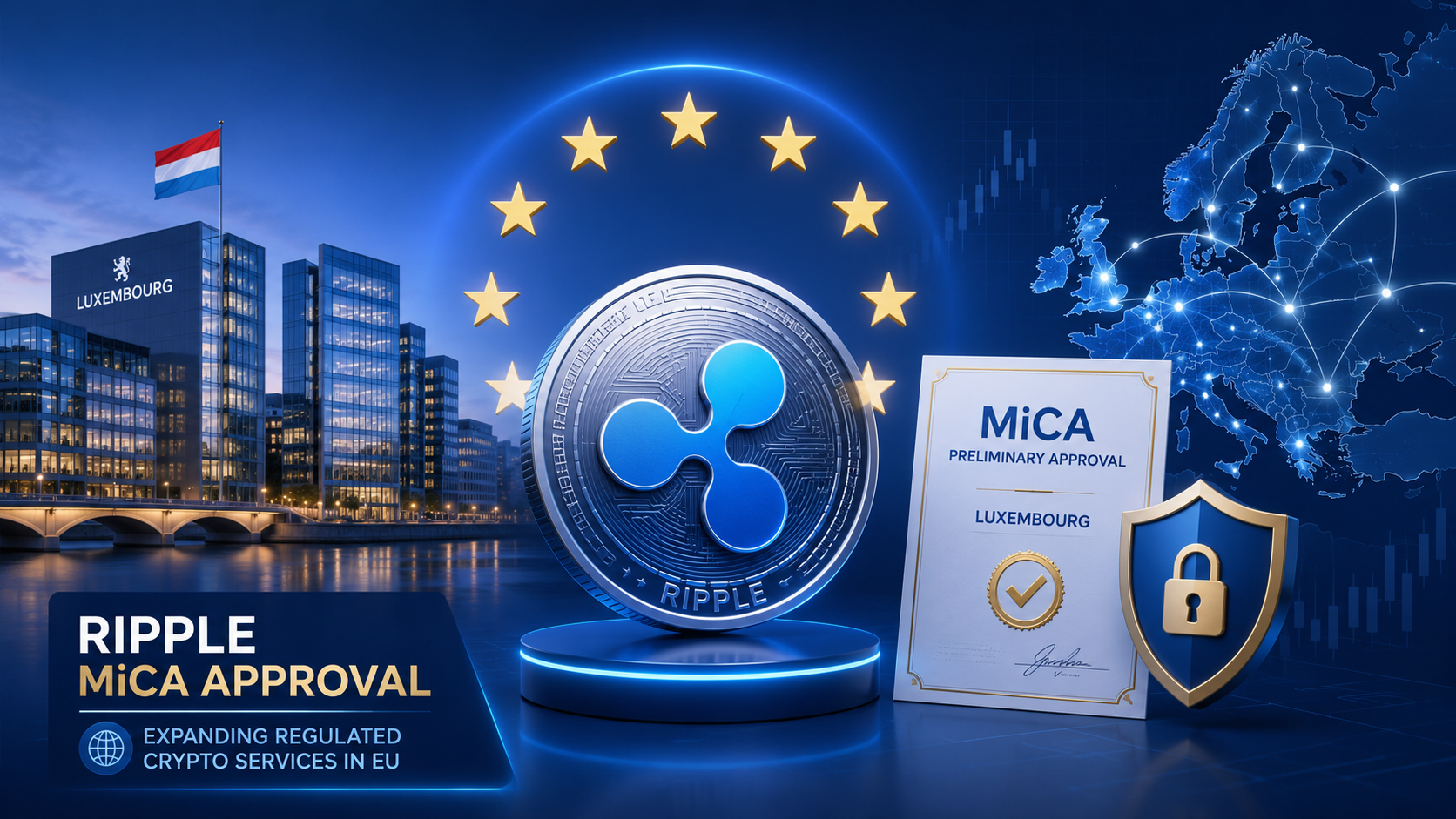
Ripple has taken another important step toward expanding its regulated presence in the European market. Luxembourg’s financial regulator has granted the company preliminary approval for a Crypto-Asset Service Provider license, known as CASP, under the European MiCA regulatory framework.
Once the approval process is completed, this license will allow Ripple to offer regulated cryptocurrency services across the entire European Economic Area. The license would provide a single regulatory mechanism that enables the company to operate in 30 EEA markets through a unified regulatory passport.
For Ripple, this approval has strategic importance. The company is already actively developing cross-border payment infrastructure, working with stablecoins and digital assets, and strengthening its cooperation with banks, fintech companies and institutional clients.
Preliminary MiCA Approval in Luxembourg
Ripple said it received preliminary approval from Luxembourg’s financial regulator for a Crypto-Asset Service Provider license. This license is issued under the European uniоn’s Markets in Crypto-Assets regulation, better known as MiCA.
MiCA has become one of the key regulatory initiatives in the EU digital asset sector. Its goal is to create unified rules for cryptocurrency companies, increase market transparency, protect users and provide a clearer legal environment for institutional participants.
For Ripple, receiving preliminary approval means the company has moved closer to offering crypto services in Europe on a regulated basis. After final approval, the company will be able to use a single regulatory passport and expand its services across the European Economic Area without needing to obtain separate permissions in each jurisdiction.
Access to 30 European Economic Area Markets
Ripple stated that the CASP license will allow it to serve banks, fintech companies and other institutional organizations across all 30 markets of the European Economic Area.
This format is especially important for companies working with cross-border payments and digital assets. Instead of a fragmented approach, where rules differ from country to country, MiCA creates a more unified and understandable regulatory regime.
For Ripple, this opens the opportunity to offer cryptocurrency services in Europe on a larger and more structured scale. The company will be able to use Luxembourg as an important regulatory base for expanding its operations throughout the region.
This may also strengthen Ripple’s position among institutional clients. Banks and fintech companies usually prefer to work with providers that have clear legal status, licenses and a transparent systеm for meeting regulatory requirements.
Connection With the EMI License in Luxembourg
The preliminary CASP approval complements Ripple’s existing Electronic Money Institution license in Luxembourg. This EMI license allows Ripple to provide regulated cross-border payment services and electronic money services in the region.
As a result, Ripple is gradually building a comprehensive regulatory foundation for its European operations in Luxembourg. The EMI license already covers electronic money and payment services, while the future CASP license should expand the company’s capabilities in the cryptoasset sector.
Ripple believes that combining these two permissions will allow it to offer a more complete infrastructure for payments using cryptoassets and stablecoins. The company intends to give clients access to such services through a single integration.
This is especially important for banks and fintech companies that need not separate disconnected tools, but ready-made infrastructure that meets regulatory requirements and can support large-scale payment processes.
MiCA Becomes an Important Stage for Europe’s Crypto Market
The Ripple decision came shortly before the July 1 transition deadline, when MiCA rules are set to apply more broadly across the European uniоn.
For cryptocurrency companies, this period is especially important. Many market participants are trying to secure the required permissions in advance in order to continue operating in the EU under the new legal regime.
MiCA is gradually becoming one of the most important regulatory benchmarks for the global crypto industry. Europe is trying to create a model that supports innovation while also setting clear rules for companies working with digital assets.
For Ripple, the European market has long had strategic importance. The company has repeatedly emphasized that it sees the region as one of the key centers for the development of payment infrastructure, digital assets and institutional solutions.
Institutional Demand in Europe Continues to Grow
According to Ripple, the regulatory clarity provided by MiCA is already helping accelerate institutional adoption of digital assets in Europe.
Ripple’s Managing Director for the UK and Europe, Cassie Craddock, noted that MiCA has helped open a new wave of institutional interest in digital assets. According to her, demand for such solutions continues to accelerate across the region.
This trend is linked to the fact that major financial organizations are increasingly viewing digital assets not only as speculative instruments, but also as part of the future payment and settlement infrastructure.
Banks, payment companies and fintech platforms are looking for solutions that can speed up international transfers, reduce costs, increase settlement transparency and improve access to liquidity. Ripple is trying to take a place in this segment by offering infrastructure for cross-border payments, stablecoins and digital assets.
Ripple Focuses on Regulated Payments and Stablecoins
The preliminary CASP approval in Luxembourg fits well into Ripple’s broader strategy. The company continues to develop infrastructure for regulated payments, cryptoassets and stablecoins.
The combination of the EMI license and the expected CASP license may allow Ripple to provide clients with a wider range of services. This is not only about traditional electronic money or cryptocurrency services separately, but about a comprehensive payment infrastructure that combines both areas.
This approach is especially relevant amid growing interest in stablecoins. More companies are considering stablecoins as a tool for fast settlements, cross-border transfers and corporate payments.
For Ripple, this direction is a logical continuation of its business. The company has spent years developing solutions for international payments and is now seeking to integrate cryptoassets and stablecoins into regulated financial infrastructure.
Luxembourg as an Important Hub for Ripple’s European Strategy
The choice of Luxembourg is important for Ripple. The country has long been considered one of Europe’s key financial centers and is actively used by international companies to build regulated operations in the EU.
Luxembourg’s regulatory framework may become a base for Ripple’s further expansion across the European Economic Area. Receiving preliminary CASP approval shows that the company is focusing on compliance with European requirements and long-term operations in the region.
For large clients, this can be an important signal. As oversight of the crypto market becomes stricter, licenses, a clear jurisdiction and a transparent structure are becoming some of the main factors of trust.
Ripple is trying to show that its cryptocurrency and payment services can develop not outside financial regulation, but within it.
Europe Becomes a Testing Ground for Global Crypto Regulation
Ripple’s progress comes as Europe effectively becomes one of the main testing grounds for crypto industry regulation.
MiCA has become the first large-scale unified regulation for digital assets at the level of a major economic bloc. Unlike many other regions where rules remain fragmented or not fully defined, the EU is trying to create a clear systеm for crypto companies, stablecoin issuers and digital asset service providers.
For global players, this creates both opportunities and challenges. On the one hand, unified rules allow businesses to plan more confidently. On the other hand, MiCA requirements force companies to go through licensing, strengthen compliance and adapt their products to European standards.
That is why cryptocurrency companies are increasingly trying to obtain approvals before key transition deadlines. For those that manage to complete this process, Europe may become one of the most attractive regulated markets.
Not All Major Players Have Received Approval Yet
At the same time, the situation in the market remains uneven. Some major cryptocurrency companies are still waiting for regulatory decisions under the new MiCA regime.
Reports also suggest that Greek regulators may be preparing to reject Binance’s MiCA application. This shows that the approval process is not a formality and may involve serious review by national regulators.
Against this backdrop, Ripple’s preliminary approval in Luxembourg appears to be an important achievement. It demonstrates that the company has advanced in the process of meeting new European requirements and strengthened its position against competitors.
For the market, this is also a signal that regulators will carefully evaluate business models, internal procedures, company reliability and the ability to operate under the new rules.
Ripple Expands Its Global Network of Licenses
Ripple already holds a significant number of regulatory permissions around the world. According to the company, it has more than 75 licenses and approvals across different jurisdictions.
Among them is authorization from the UK Financial Conduct Authority, which Ripple received in January 2026. This approval also became an important part of the company’s European and international strategy.
Having a large number of licenses helps Ripple position itself as one of the most regulation-focused players in the crypto industry. At a time when regulatory pressure on the market is increasing, this strategy may become a significant competitive advantage.
The company aims to work not only with the retail crypto market, but also with banks, payment organizations, fintech companies and other institutional clients. For this audience, legal certainty and regulatory compliance are often crucial.
What This Means for Ripple
The preliminary MiCA approval in Luxembourg strengthens Ripple’s position in Europe and brings the company closer to launching a broader range of regulated crypto services across the EEA.
After receiving the final license, Ripple will be able to develop services for banks, fintech companies and other organizations within a unified regulatory environment. This may simplify the launch of products linked to digital assets, stablecoins and cross-border payments.
For the company, this is not only a regulatory success, but also an important strategic step. Ripple gains the opportunity to strengthen its European business at a time when institutional demand for digital assets is growing and the market is moving toward stricter and clearer rules.
If the license is finally approved, Ripple will be able to use Luxembourg as an entry point for large-scale expansion of regulated crypto services across the European Economic Area.
What This Means for the European Crypto Market
Ripple’s approval also matters for the European crypto market. It shows that major international companies are ready to adapt to MiCA and build their operations under the new legal regime.
This may accelerate the development of regulated crypto infrastructure in Europe. The more large players receive licenses and begin operating under unified rules, the higher the likelihood of growing trust from banks, institutional investors and major corporate clients.
At the same time, MiCA may increase the divide between companies that are ready to operate under transparent regulation and those that cannot or do not want to meet the new requirements.
For users and institutional clients, this could mean a safer and more predictable market. For crypto companies, it means the need to improve compliance, reporting and internal processes.
Conclusion
Ripple has received preliminary approval from Luxembourg’s financial regulator for a CASP license under the European MiCA regulatory framework.
After final approval, the license will allow the company to offer regulated cryptocurrency services across all 30 markets of the European Economic Area through a single regulatory passport.
The approval complements Ripple’s existing Electronic Money Institution license in Luxembourg, which allows the company to provide regulated payment services and electronic money services.
Ripple plans to combine the EMI license and future CASP license to develop comprehensive infrastructure for cryptoassets, stablecoins and cross-border payments.
The company believes MiCA is accelerating institutional adoption of digital assets in Europe and creating a clearer legal environment for market participants.
Ripple already holds more than 75 regulatory licenses and approvals worldwide, including authorization from the UK Financial Conduct Authority.
If the final license is granted, Ripple will be able to significantly expand its regulated presence in Europe and strengthen its position in the crypto payments and digital asset market.
This material is for informational purposes only and does not constitute investment advice.