




Cryptocurrency Monero (XMR)
Based on the anonymous payment protocol CryptoNote, the cryptocurrency Monero (XMR) appeared in the spring of 2014 under the name BitMonero. Its creators aimed to address the “critical flaws” of Bitcoin, such as the ease of tracking transactions and the simplicity of deanonymizing cryptocurrency owners.
The first cryptocurrency based on the CryptoNote protocol was Bytecoin, released in July 2012. However, in April 2014, it unexpectedly became known that the developers had pre-mined about 80% of all coins. The cryptocurrency community reacted sharply, and within three months, about a dozen forks of Bytecoin appeared to address this “flaw”.
Rise in Popularity
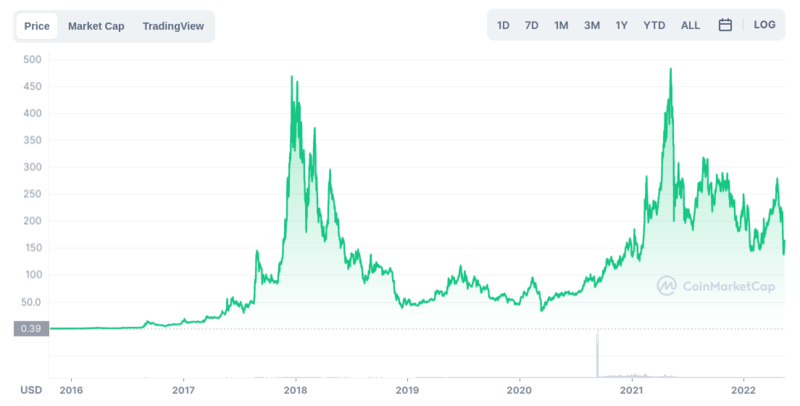
Monero gained recognition in 2016 when its value increased by almost 2800% – from 50 cents per coin to 16 dollars at its peak, making it the most profitable asset of that year.
Any actively used digital currency eventually faces the problem of blockchain “bloat”. The issue is not only in the size of the blockchain but also in the increasing number of transactions that the block cannot accommodate. This leads to a decrease in transaction confirmation speed and an exponential increase in network fees.
Monero was no exception. Due to the need to conceal the transfer amount, the size of a transaction in Monero with one output was about 12 kilobytes until October 18, 2018. Therefore, by that time, the coin’s blockchain had bloated to 60 gigabytes. However, after the activation of the new confidential transaction protocol Bulletproofs on October 18, the size of a single transaction was reduced by as much as 80% – to approximately two kilobytes.
Mining Monero
Initially, the original CryptoNote protocol algorithm (CryptoNight), based on the PoW consensus mechanism, was used to find blocks in Monero. This algorithm was specifically designed to be ASIC-resistant but proved not entirely resistant in practice. The growing popularity of the coin attracted interest from mining giants, and in 2018, companies Baikal and Bitmain created hardware devices for the CryptoNight algorithm, leading to the rapid monopolization of Monero mining.
An example of such a device for mining Monero and other cryptocurrencies on the CryptoNight algorithm, created by the Chinese company Bitmain (Antminer X3)
The monopolization of mining made a 51% attack on the cryptocurrency network possible. To prevent this threat, developers switched to the modified CryptoNightR mining algorithm in March 2019, and in December of the same year – to the newly developed RandomX algorithm, which is believed to have permanently ended Monero mining on ASIC devices.
In May 2020, Monero added support for the Dandelion protocol (Dandelion++), designed to obfuscate the IP address of the network node from which the transaction is sent. Knowing this address can lead to the deanonymization of the sender, so it is not surprising that the protocol developed for Bitcoin was adapted for Monero.
Looking to the future, it is worth noting that another updаte to the Monero codebase is planned for mid-July 2022. This includes transitioning to an improved version of Bulletproofs (Bulletproofs+), which will further reduce transaction sizes and increase network performance.
In Search of the Ideal Cryptocurrency
According to Edward Snowden, “Bitcoin is not as private as you think” – this cryptocurrency does not provide sufficient privacy for those who do not want to “shine” their transactions. However, the “king of cryptocurrencies” never claimed to be a payment or investment asset protected from prying eyes.
When we transfer money using a plastic card, all information about the movement of funds (and their owners) is only available to the banks processing the payment or transfer. Even a powerful state is sometimes powerless in finding the “ends” – especially when it comes to cross-border transfers.
Only multi-billion dollar fines and threats of a total ban on activities within the country helped the powerful US “convince” Swiss banks to provide access to information about accounts opened by American citizens (US tax residents).
As a result, we have two extremes – on one side, there is a decentralized and open systеm (like Bitcoin), and on the other side, a closed (for outsiders) and fully centralized banking systеm. This highlights the fundamental contradiction between decentralization and confidentiality.
Confidential money can be created (cash already is), and an attempt can be made to make it fully decentralized – this is the goal of all cryptocurrencies (with a few exceptions like Ripple and stablecoins). But is it possible to create a truly decentralized and completely anonymous coin?
Monero is trying to find the answer to this question in practice.
Striving for the Ideal Cryptocurrency
In an ideal case, money should meet the following requirements:
- decentralization
- confidentiality
- fungibility
Decentralization is the foundation for meeting the requirements of confidentiality and fungibility. Full decentralization is impossible without a large number of independent miners.
The developers of Monero have repeatedly stated and confirmed in practice that they will not allow the monopolization of mining. The currently used RandomX algorithm is optimized for mining on regular computers with CPUs, not requiring powerful graphics cards. It all depends on Monero miners.
Although Bitcoin is considered a decentralized coin, the concentration of hashrate in the hands of a small group of mining pools casts doubt on the real level of decentralization. In a certain sense, pools can be seen as banks processing transfers and payments in national currencies.
Simply put, in conditions of hashrate concentration, one can forget about anonymous transactions, which in Bitcoin and most other cryptocurrencies are not anonymous by default.
The inability of anonymous transactions ultimately makes fungibility impossible. Tracking individual payments in the blockchain allows “marking” coins used in criminal schemes (e.g., through the creation and maintenance of a blacklist of addresses).
Current holders of such “tainted” coins face difficulties in their circulation (e.g., selling), even if they did not participate in illegal activities and received the cryptocurrency quite legally.
Anonymous Transactions in Monero
If we open a Monero transaction in the blockchain explorer of this cryptocurrency, we will see, or rather, not see the sender’s address, the recipient’s address – or even the amount transferred:
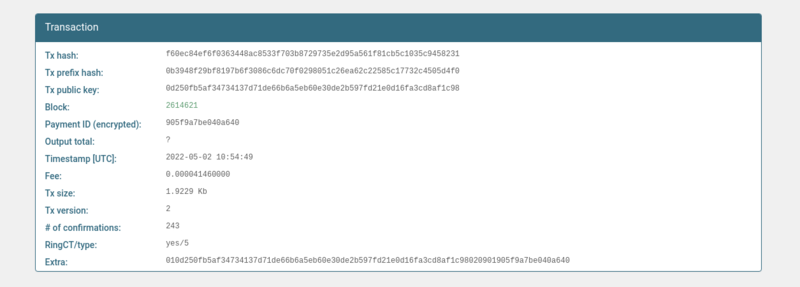
The ring signature technology used in Monero does not allow determining who created the transaction, one-time addresses also hide the recipient, and the zero-knowledge proof protocol (Bulletproofs) gives miners the ability to verify the correctness of the payment amount (wallet balance compliance) without presenting it in open form.
If it is impossible to determine either the recipient or the sender, then it becomes impossible to distinguish one coin from another. Thus, the requirement for the fungibility of cryptocurrency units is automatically fulfilled.
Through the decentralization of mining (RandomX), the technology of confidential transactions (RingCT), and the obfuscation of node addresses in the network (Dandelion), Monero strives to make money as anonymous, decentralized, and fungible as possible. Regular addition and use of new technologies (often earlier than other cryptocurrencies) confidently bring Monero closer to this goal, to the extent that it is achievable at all.
What is the Future for Monero?
Like Bitcoin, the cryptocurrency Monero started from virtually nothing, and its price has risen from mere cents to hundreds of dollars:
Recently, peer-to-peer marketplaces have started showing interest in Monero.
Monero has never claimed to be revolutionary, has not sought cheap PR or venture financing (unlike its competitor Zcash). Despite bans on some cryptocurrency exchanges, the results achieved by the coin can certainly be considered a success, and the development – natural and consistent, “keeping up with the times”.
Therefore, it is hardly worth writing it off – such coins are surprisingly resilient.