



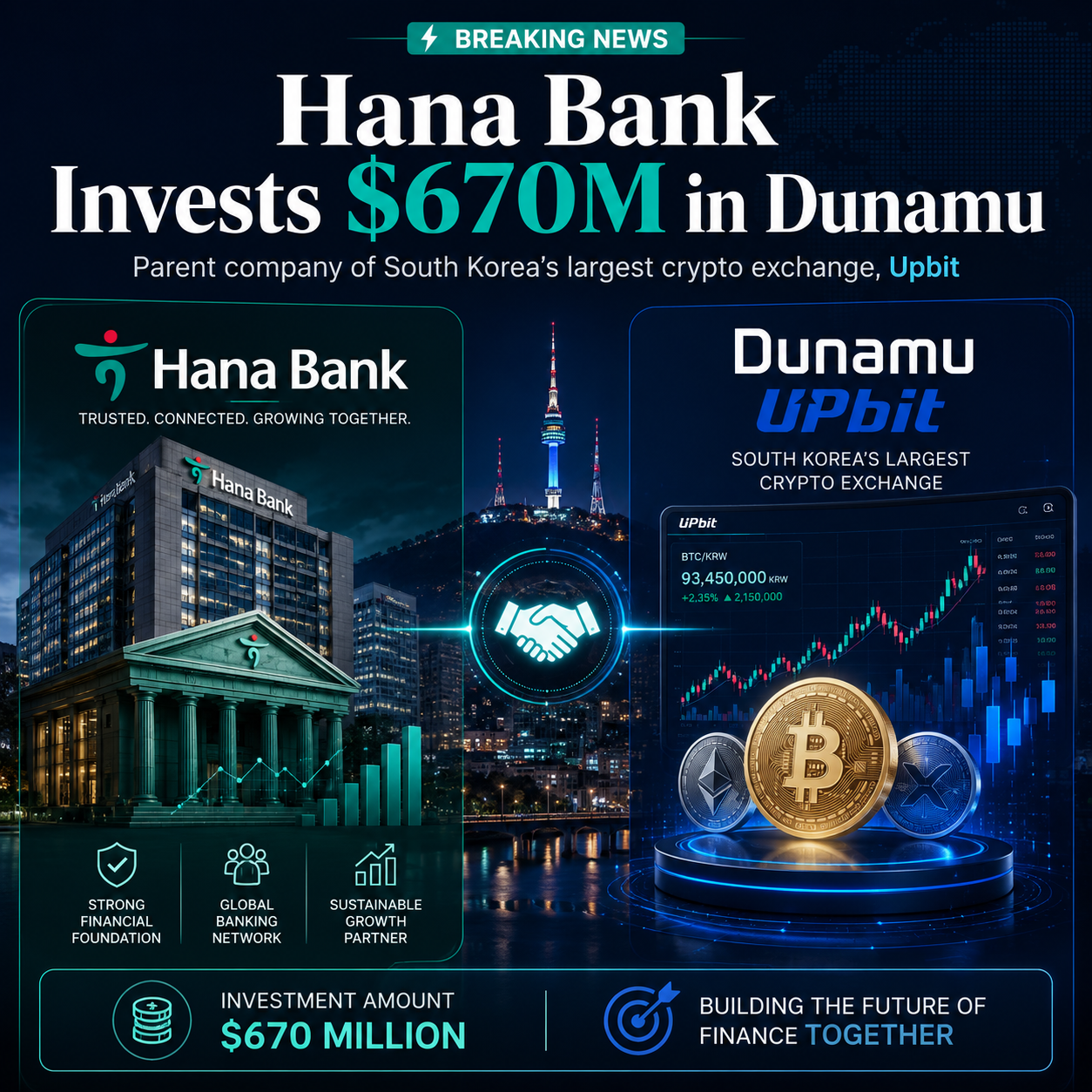
According to disclosed information, Hana Bank will acquire 2.28 million shares of Dunamu from Kakao Investments for 1.003 trillion Korean won, equivalent to around $669.2 million. After the transaction is completed, the bank will own a 6.55% stake in Dunamu, becoming the company’s fourth-largest shareholder.
Hana Bank Acquires Stake in Dunamu
South Korean banking giant Hana Bank announced the acquisition of a major stake in Dunamu, the operator of cryptocurrency exchange Upbit. The investment is valued at approximately 1 trillion Korean won, or about $670 million.
The purchase will be made from Kakao Investments, which will sell 2.28 million shares of Dunamu. Following the transaction, Kakao Investments’ ownership in Dunamu will decrease to 4.03%.
For Hana Bank, the investment represents a strategic move aimed at strengthening its position in the rapidly evolving financial sector, where digital assets, blockchain infrastructure, and cryptocurrency services are becoming increasingly important.
Key Deal Details
| Category | Details |
|---|---|
| Buyer | Hana Bank |
| Seller | Kakao Investments |
| Company | Dunamu |
| Dunamu’s Main Asset | Upbit cryptocurrency exchange |
| Number of Shares | 2.28 million |
| Deal Value | 1.003 trillion won |
| Estimated USD Value | Approximately $669.2 million |
| Hana Ownership After Deal | 6.55% |
| Kakao Investments Stake After Sale | 4.03% |
| Expected Closing Date | June 15 |
Hana to Become Dunamu’s Fourth-Largest Shareholder
After the acquisition is finalized, Hana Bank will hold a 6.55% stake in Dunamu, making it the company’s fourth-largest shareholder.
This position gives Hana a stronger presence within one of South Korea’s most influential crypto companies. While the investment does not represent a controlling stake, it could open the door to strategic cooperation in digital assets, payments, custody services, and Web3 infrastructure.
The transaction will be funded with cash and will account for approximately 2.78% of Hana’s capital. Completion is scheduled for June 15.
Why the Deal Matters for South Korea
Hana Bank’s investment in Dunamu highlights the growing convergence between traditional banking and cryptocurrency infrastructure in South Korea.
Major banks are increasingly exploring digital assets, stablecoins, custody solutions, blockchain payments, and institutional crypto infrastructure.
This is especially significant for South Korea, which remains one of the world’s most active cryptocurrency markets. Retail traders, technology companies, and financial institutions all play an important role in the country’s digital economy.
Dunamu and the Role of Upbit
Dunamu operates Upbit, the largest cryptocurrency exchange in South Korea. Upbit dominates the domestic market and is estimated to control more than 80% of local crypto trading volume.
The exchange is also among the world’s largest spot trading platforms, regularly recording daily trading volumes exceeding $1 billion.
This makes Dunamu one of the most strategically important digital asset infrastructure companies in South Korea. Hana’s investment effectively gives the bank exposure to one of the country’s strongest digital financial ecosystems.
Hana Expands Its Presence in Digital Assets
Hana Financial Group has steadily expanded its involvement in digital assets over the past several years. The group is one of South Korea’s largest financial institutions and previously reported annual net profits of around 4 trillion won.
The company has already participated in several crypto and blockchain initiatives. These inсlude partnerships between Hana Card and Circle, as well as Crypto.com, focused on USDC-related activities and digital asset marketing campaigns.
Hana Bank also collaborated with Standard Chartered on digital asset initiatives and previously partnered with SK Telecom and BitGo to launch BitGo Korea, in which Hana owns a 25% stake.
Why Banks Are Interested in Crypto Infrastructure
Banks are increasingly viewing digital assets not only as an investment class but also as an infrastructure opportunity.
Traditional financial institutions are becoming interested in crypto for several reasons:
- growing customer demand for cryptocurrency services;
- expansion of stablecoins and blockchain-based payments;
- institutional demand for digital asset custody;
- development of real-world asset tokenization;
- competition with fintech firms and crypto exchanges;
- the need to participate in the next generation of financial infrastructure.
Against this backdrop, acquiring a stake in Dunamu may help Hana strengthen its role within the future digital financial ecosystem.
Upbit as a Strategic Asset
Upbit is more than just a cryptocurrency exchange. It is a major infrastructure platform with a large user base, strong liquidity, and one of the most recognizable brands in South Korea’s crypto industry.
For Hana Bank, holding equity in a company connected to Upbit could provide a strategic advantage if regulations eventually allow traditional financial institutions to offer broader cryptocurrency-related products.
Potential areas of synergy may inсlude banking integrations, fiat on-ramp and off-ramp services, custody solutions, stablecoin infrastructure, institutional products, and digital asset payment systems.
Potential Dunamu and Naver Financial Deal
Market reports have also suggested that Dunamu is exploring a potential merger or strategic partnership with Naver Financial. If such a deal materializes, it could further strengthen the position of Dunamu and Upbit.
Naver is one of South Korea’s largest technology companies, while Naver Financial operates digital financial services within one of the country’s largest internet ecosystems.
A combination of Upbit’s crypto infrastructure, Naver Financial’s fintech ecosystem, and major banking partnerships could create one of the most influential digital finance platforms in Asia.
The Convergence of Banking and Crypto
The Hana Bank and Dunamu transaction reflects the broader convergence of traditional finance and the cryptocurrency industry.
While banks previously distanced themselves from crypto due to regulatory and reputational concerns, many large financial institutions are now seeking exposure through partnerships, minority investments, custody solutions, and infrastructure projects.
This strategy allows banks to gain access to rapidly growing technologies without immediately becoming full-scale crypto exchange operators.
Regulatory Environment
South Korea remains one of Asia’s most heavily regulated cryptocurrency markets. The country enforces strict rules regarding exchange operations, real-name banking systems, AML procedures, and customer protection.
Against this backdrop, the participation of a major bank in Dunamu may be seen as a strong signal of increasing institutional acceptance of the cryptocurrency sector.
However, the future growth of similar deals will likely depend on regulatory policies, risk management requirements, and evolving rules governing cooperation between banks and crypto companies.
Conclusion
Hana Bank is acquiring a 6.55% stake in Dunamu, the parent company of Upbit, for 1.003 trillion won, or approximately $669.2 million. The deal is expected to close on June 15.
Following the acquisition, Hana will become Dunamu’s fourth-largest shareholder, while Kakao Investments will reduce its ownership stake to 4.03%.
The investment highlights the growing interest among South Korean banks in digital assets, cryptocurrency infrastructure, and next-generation financial technologies. For Hana, the move represents a strategic step into a market where Upbit remains the dominant player and Dunamu continues to strengthen its position as a central pillar of South Korea’s digital financial ecosystem.