



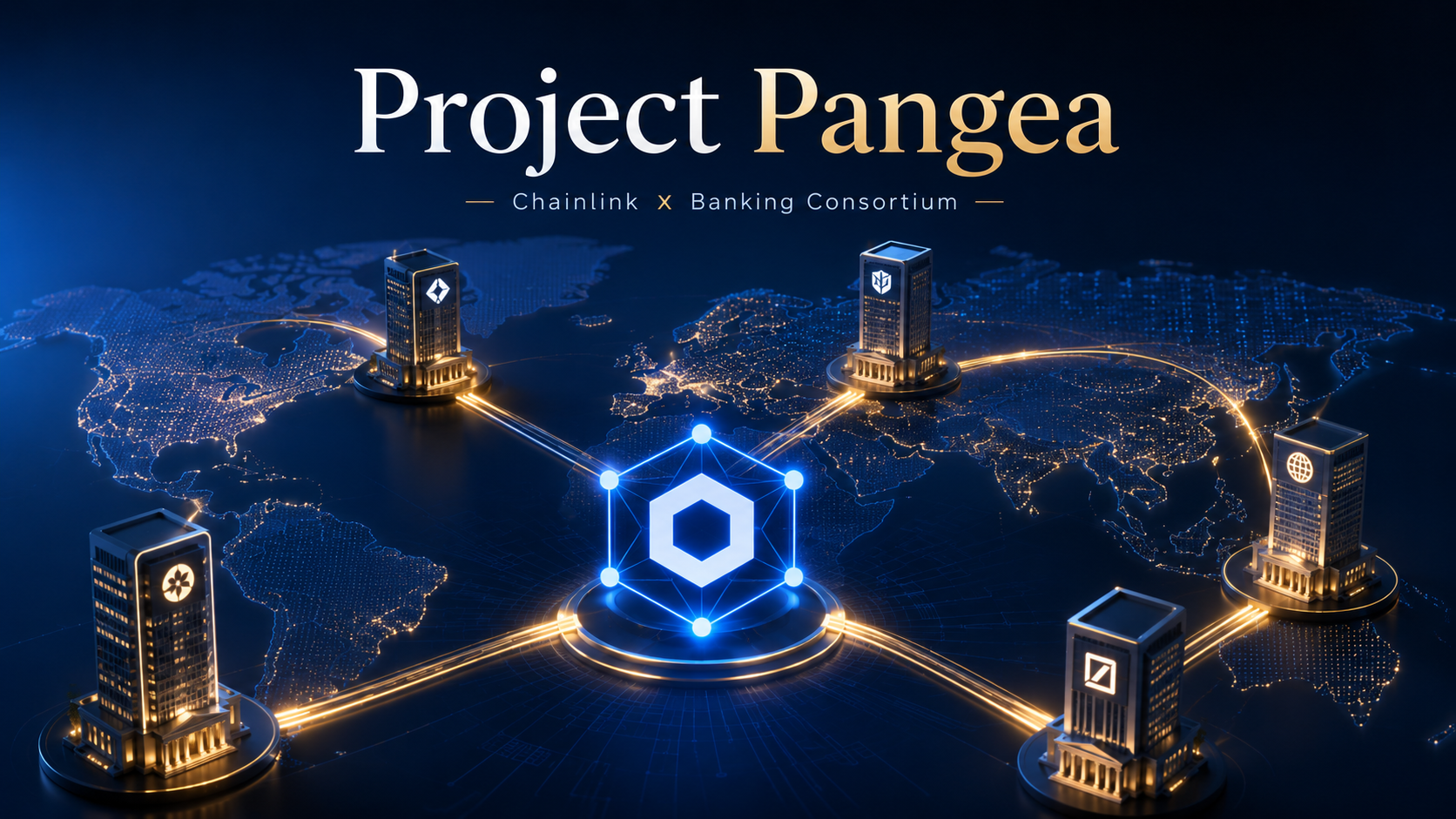
Chainlink has announced a partnership with a multinational banking consortium that is launching Project Pangea. The initiative is focused on creating a new solution for international foreign exchange markets and cross-border settlements.
Project Pangea brings together more than 50 banks representing over $10 trillion in assets under management. The main goal of the initiative is to unlock T+0 settlement for international transactions using Chainlink standards, ISO 20022 and existing Swift infrastructure.
Pangea could become an important step for the banking sector, as the project offers a faster, more technological and interoperable approach to currency operations between financial institutions.
Banks Will Be Able to Conduct Atomic FX Swaps
The project is based on the use of Chainlink, ISO 20022 messaging and Swift infrastructure. This will allow banks to directly conduct atomic PvP swaps of regulated stablecoins denominated in euros and South Korean won.
This model allows two parties to exchange assets using the Payment-versus-Payment principle, reducing settlement risks and increasing the reliability of transactions. In traditional FX settlements, delays can take a significant amount of time, while Pangea is aimed at instant execution and final settlement.
The project is expected to unlock several key opportunities for banks: atomic FX transactions, instant T+0 settlement and access to liquidity in an on-chain environment.
For international financial markets, this could become an important change, as currency operations may be executed faster, more transparently and with less dependence on outdated settlement processes.
Chainlink’s Role in Project Pangea
As part of Pangea, Chainlink provides the data, interoperability and orchestration standards required for complex cross-chain and cross-border transactions.
This is especially important for banks, as they need to work not only with blockchain networks, but also with existing financial systems. Chainlink enables traditional banking infrastructure to connect with public and private blockchains without requiring institutions to completely rebuild their current processes.
One of Chainlink’s key advantages is its ability to connect banks to different networks using familiar messaging standards. This lowers the technical barrier for implementing blockchain solutions into traditional financial infrastructure.
Project Pangea shows that banks are increasingly viewing blockchain not as a separate cryptocurrency sector, but as a technological foundation for more efficient settlements, tokenized assets and international payments.
Chainlink as Infrastructure for Financial Markets
Chainlink is one of the leading oracle platforms in the blockchain industry. Its technology enables secure data transfer between external systems and smart contracts, while also supporting interoperability between different blockchain networks and financial infrastructures.
The platform already plays a major role in decentralized finance and is gradually becoming an important component for institutional blockchain adoption. Chainlink is used for data transmission, process automation, information verification and ensuring the reliable operation of smart contracts.
As interest in stablecoins, real-world asset tokenization and blockchain adoption by traditional financial institutions continues to grow, Chainlink’s role may become even more significant.
Project Pangea fits well into this trend. It demonstrates how Chainlink infrastructure can be used not only in DeFi, but also in banking settlements, FX operations and institutional financial products.
LINK and the New Fee Model
The Chainlink ecosystem operates using the LINK token. It is used to pay for platform services and support the proper functioning of the network.
In addition, Chainlink is introducing a new fee model under which revenues from enterprise adoption, both on-chain and off-chain, may be converted into LINK tokens and allocated to the Chainlink strategic reserve.
This model is designed to strengthen the connection between real-world usage of Chainlink infrastructure and the economics of the LINK token. As institutional adoption of the network grows, this may increase the token’s importance within the ecosystem.
For Chainlink, it is important not only to expand the technological use of its platform, but also to build a sustainable economic model that reflects demand from banks, companies and blockchain applications.
Traditional Finance Is Increasingly Using Chainlink
Chainlink remains one of the key participants in the global tokenization trend. Traditional financial institutions and infrastructure organizations are increasingly viewing its technology as a foundation for moving financial assets and operations into the blockchain environment.
Chainlink has already been associated with initiatives and integrations involving organizations such as SWIFT, DTCC, Euroclear, J.P. Morgan, Mastercard, the Central Bank of Brazil, UBS, SBI, Fidelity International, ANZ and other major financial market participants.
Interest from such organizations shows that blockchain infrastructure is gradually becoming part of global financial processes. This is not only about cryptocurrencies, but also about tokenized assets, settlements, payments, data and the automation of financial operations.
Chainlink is at the center of this movement because it offers infrastructure that helps connect traditional capital markets with blockchain technology.
Why Project Pangea Matters
The main purpose of Pangea is to make international currency settlements faster, more reliable and more compatible with modern digital financial instruments.
The use of atomic PvP swaps can reduce risks associated with one side of a transaction fulfilling its obligations before the other. This model is especially important for FX markets, where transaction volumes are enormous and settlement delays can create additional risks and costs.
Instant T+0 settlement may also improve capital efficiency. Banks and financial institutions will not need to wait several days for final transaction completion, which may improve liquidity management.
Access to on-chain liquidity, in turn, opens the door to more flexible use of digital assets and stablecoins within a regulated banking environment.
Chainlink and the Future of Tokenization
Project Pangea reflects a broader trend: traditional financial institutions are gradually moving from testing blockchain technology to building practical solutions.
Real-world asset tokenization, regulated stablecoins, digital FX settlements and integration with banking infrastructure are becoming some of the main directions in the development of financial markets.
Chainlink aims to take a central role in this process by providing standards for data, interoperability and secure information transfer between blockchains and traditional financial systems.
If projects such as Pangea gain wider adoption, they could change the way banks approach cross-border settlements and currency operations.
LINK Market Dynamics
Amid the news around Project Pangea, the LINK token remains an important part of the Chainlink ecosystem. According to the provided market data, LINK fell by around 3% over the past 24 hours and traded near $7.60.
Short-term price movement may depend on the overall crypto market situation, investor sentiment and liquidity. However, from a fundamental perspective, attention to Chainlink is linked not only to the token price, but also to the growing use of the network in institutional and decentralized scenarios.
As banks, payment companies and infrastructure organizations explore blockchain solutions, demand for reliable data and interoperability standards may continue to grow.
Conclusion
Chainlink announced a partnership with a multinational banking consortium as part of Project Pangea.
The initiative brings together more than 50 banks representing over $10 trillion in assets under management.
The project is focused on launching cross-border T+0 settlements using Chainlink standards, ISO 20022 and Swift infrastructure.
Pangea will allow banks to conduct direct atomic PvP swaps of regulated EUR and KRW stablecoins.
Chainlink provides data, interoperability and orchestration standards for complex cross-chain and cross-border transactions.
The project highlights Chainlink’s growing role in tokenization, institutional blockchain adoption and the modernization of financial markets.
LINK remains the key token of the Chainlink ecosystem and is used to pay for platform services and support network operations.
This material is for informational purposes only and does not constitute investment advice.