



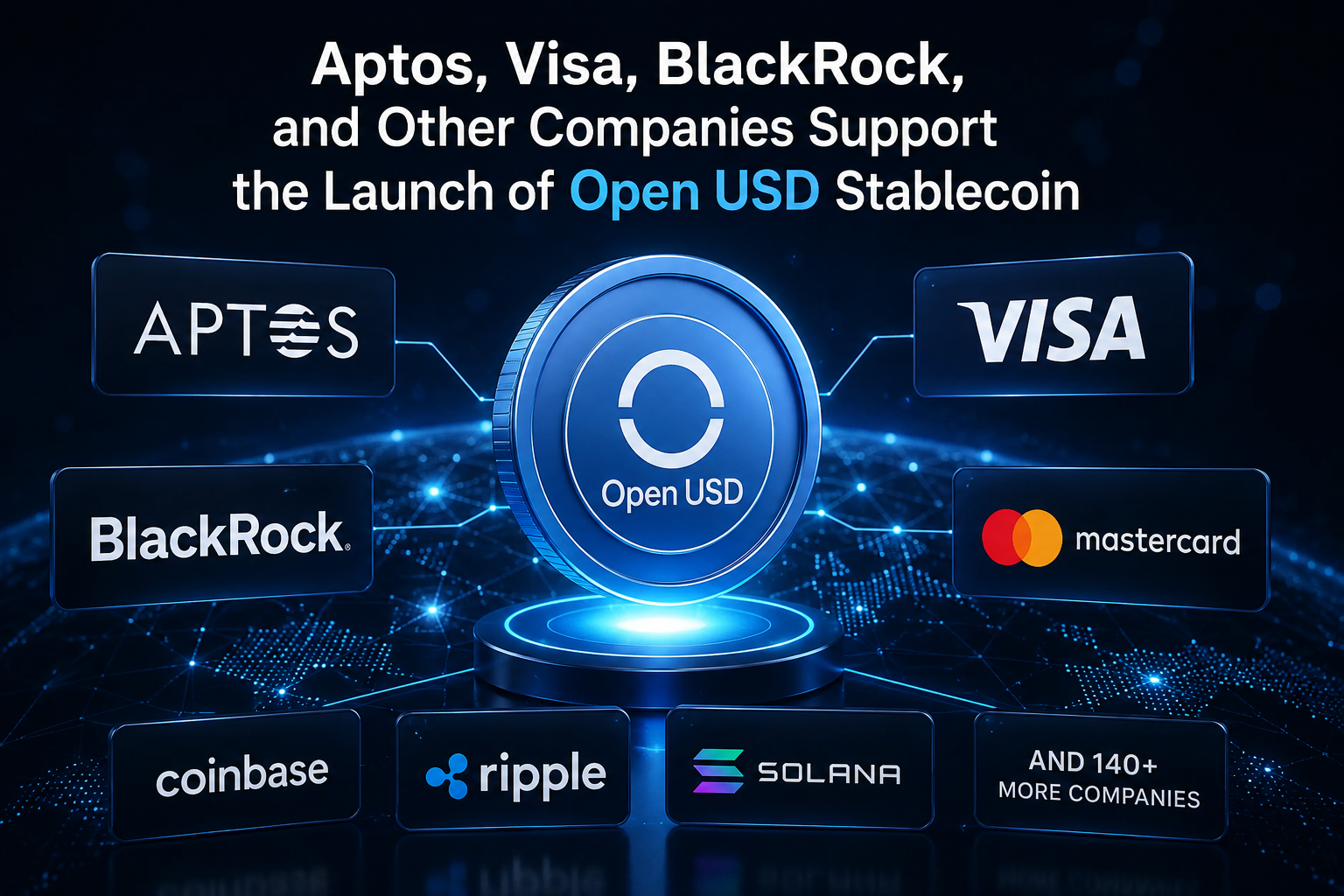
Aptos Labs has joined a coalition of more than 140 companies participating in the launch of the new enterprise-focused stablecoin Open USD. The initiative’s partners also inсlude Visa, Mastercard, Coinbase, BlackRock, Ripple, and Solana.
The new digital asset is being developed by Open Standard and is primarily aimed at companies that use blockchain technology for payments and financial operations.
The project’s main goal is to reduce transaction costs, simplify access to digital payments, and address the limitations associated with many existing stablecoins.
The developers intend to create an open and business-friendly model that will allow companies not only to use the stablecoin for settlements, but also to participate in ecosystem governance and share in the income generated by reserve assets.
More Than 140 Organizations Support the Initiative
Aptos Labs announced its participation in the project through the X social media platform. The coalition includes representatives from traditional finance, the payments industry, technology companies, and blockchain projects.
Participants in the initiative inсlude:
- Visa;
- Mastercard;
- Coinbase;
- BlackRock;
- Ripple;
- Solana;
- Aptos Labs.
The range of participating companies highlights the developers’ intention to combine traditional financial infrastructure with the capabilities of public blockchains.
Key Features of Open USD
The Open USD architecture is based on three core principles designed to make the stablecoin more attractive to corporate clients.
Free Minting and Redemption
Companies will be able to mint and redeem Open USD without paying additional fees, regardless of the size or number of transactions.
The absence of fees and artificial limits is expected to make the stablecoin suitable for large corporate payments, internal settlements, and cross-border transfers.
Revenue Sharing With Partners
One of the main differences between Open USD and other stablecoins will be its mechanism for distributing profits generated by reserve assets.
Organizations participating in the ecosystem will be able to receive a share of the income generated by the assets backing the digital currency. A small management fee will be deducted to cover the project’s operating expenses.
As a result, partners will be able not only to use Open USD for settlements, but also to benefit financially from their participation in the systеm.
Community-Based Governance
Open USD will not be controlled exclusively by a single issuer. The project is expected to be governed through Open Standard, an independent organization.
Its board of directors will inсlude representatives of the companies and partner organizations participating in the initiative.
This model is intended to provide more balanced decision-making and reflect the interests of the entire ecosystem rather than those of a single controlling entity.
Why Open USD Is Designed for Businesses
Many existing stablecoins were originally created for cryptocurrency trading, DeFi applications, and retail users.
Open USD, by contrast, is being developed as a payment instrument for companies that require high throughput, transparent reserves, and predictable operating costs.
Free token minting and redemption could reduce costs for businesses, while the ability to receive a share of reserve income may provide an additional incentive for new partners to join the ecosystem.
Support from major financial and technology companies may also simplify the integration of Open USD with existing payment systems and corporate infrastructure.
Aptos’ Role in the Project
Aptos is a scalable Layer 1 blockchain operating through a Proof-of-Stake consensus mechanism. The network’s native token is APT.
The project uses the Move smart contract programming language, which was developed by engineers behind the Diem blockchain project previously associated with Meta.
Aptos aims to build infrastructure capable of supporting the widespread adoption of Web3 applications and services that address practical needs for users and businesses.
Aptos Labs’ participation in the Open USD initiative aligns with the project’s strategy of developing high-performance blockchain infrastructure for corporate payments.
Aptos Network’s High Transaction Throughput
The Aptos team claims that the network’s architecture is theoretically capable of processing more than 150,000 transactions per second.
This performance is enabled by the Block-STM parallel transaction execution mechanism.
Unlike blockchains where transactions are processed sequentially, Aptos can execute multiple independent transactions simultaneously.
Sequential processing may cause delays because a failed transaction or a sudden increase in network demand can slow down the execution of other operations.
The parallel approach allows the network to use resources more efficiently and reduce delays during periods of high user activity.
By comparison, the throughput of the Ethereum mainnet is generally estimated at approximately 12–15 transactions per second.
Aptos Consensus Mechanism and Security
Aptos uses a Proof-of-Stake consensus mechanism with Byzantine fault tolerance. This architecture is designed to maintain stable network operation even when some validators are faulty or acting dishonestly.
The combination of PoS consensus and parallel transaction execution allows the network to maintain high performance without compromising security requirements.
Aptos’ scalability could play an important role in processing corporate payments if Open USD achieves widespread adoption among companies and financial institutions.
Aptos Raised $400 Million in Funding
In March 2022, Aptos raised $200 million in a seed funding round led by venture capital firm Andreessen Horowitz, also known as a16z.
Tiger Global, Multicoin Capital, and other major investment firms also participated in the round.
Several months later, the startup completed a Series A funding round and raised an additional $200 million.
Participants included Dragonfly, Apollo Global, Franklin Templeton, Animoca Brands, and Jump Crypto.
The total funding raised through the two rounds amounted to approximately $400 million.
APT Token Price Performance
Following news of Aptos’ participation in the new initiative, the APT token rose by approximately 3.5% and traded near $0.5904 per coin.
However, short-term price movements alone do not provide an accurate indication of the asset’s future prospects. APT’s value may be influenced by broader cryptocurrency market conditions, network activity, ecosystem development, and new partnerships.
What Open USD Could Mean for the Stablecoin Market
The launch of Open USD could become a significant development in the corporate digital payments market.
The project combines free token minting and redemption, revenue distribution among partners, and a collective governance model.
If successfully implemented, this structure could offer businesses an alternative to traditional stablecoins, which are generally controlled by a single issuer and do not distribute reserve income among ecosystem participants.
Support from Visa, Mastercard, Coinbase, BlackRock, Ripple, Solana, Aptos, and other organizations could accelerate the integration of Open USD into payment and blockchain services.
The project’s future development will depend on reserve transparency, regulatory compliance, infrastructure reliability, and actual demand from corporate users.
A New Stage in the Integration of Blockchain and Traditional Finance
The Open USD initiative reflects the growing interest of major financial and technology companies in using blockchain technology for corporate settlements.
Stablecoins are gradually expanding beyond cryptocurrency trading and are increasingly being used for international transfers, liquidity management, business-to-business settlements, and the tokenization of financial assets.
Open USD could become another step toward connecting the traditional financial systеm with public blockchain infrastructure.
The participation of more than 140 companies demonstrates market interest in developing open, scalable, and cost-effective digital payment solutions for businesses.