



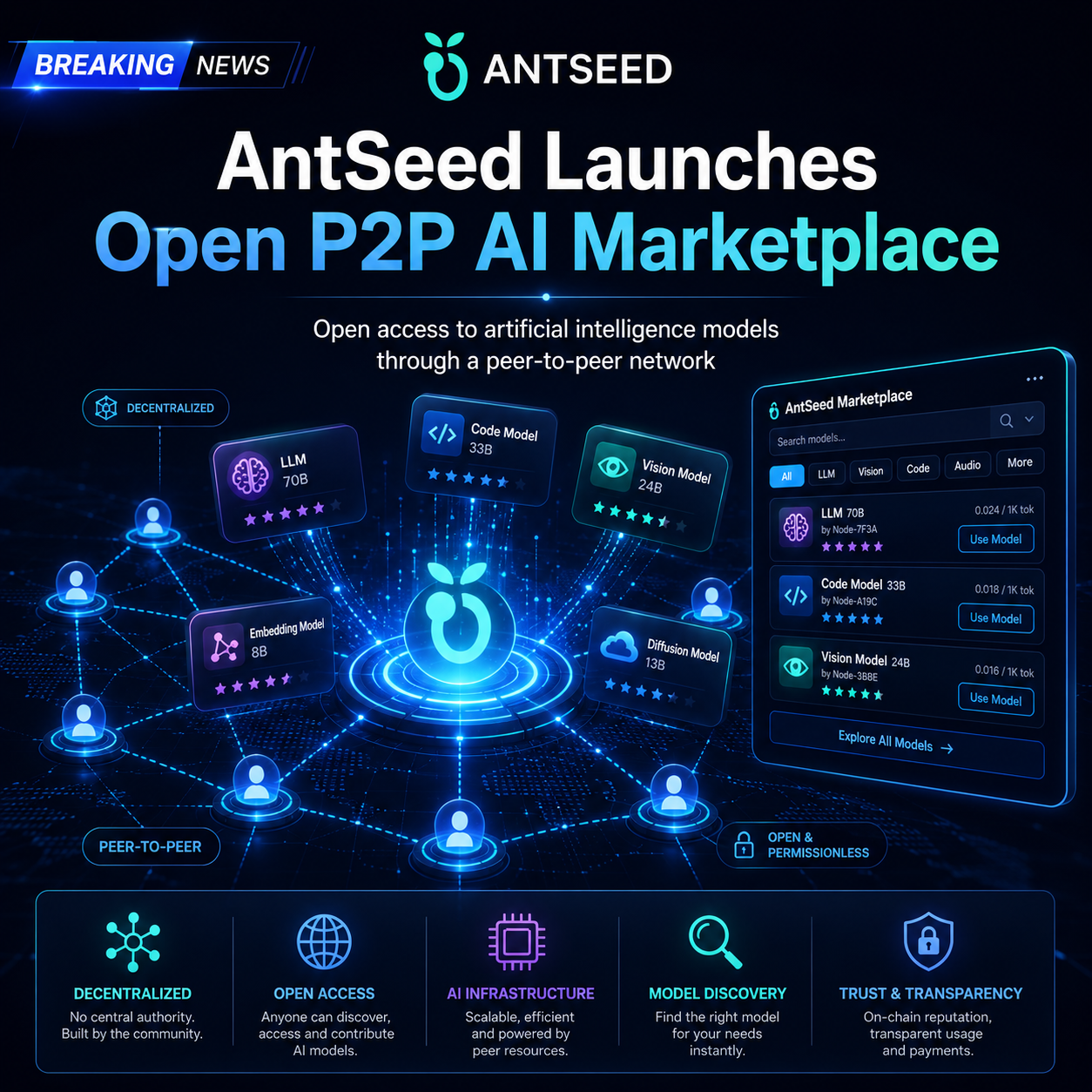
According to the company, the network is already available at antseed.com. The project positions itself as a decentralized alternative to services such as OpenRouter, but with a different architecture: instead of centralized control over model listings, payments, and access, AntSeed moves these processes into a peer-to-peer network and onchain infrastructure.
AntSeed Launches a P2P Marketplace for AI Models
On Friday, May 15, AntSeed announced the launch of an open marketplace where AI service consumers can connect directly with model providers. Unlike traditional aggregators, the project does not rely on a single centralized platform to manage requests, listings, or settlements.
The AntSeed team stated that its approach removes the intermediary layer between users and artificial intelligence providers. This is intended to make the AI access market more open, transparent, and resistant to centralized restrictions.
Buyers connect directly to providers, requests are transmitted through a peer-to-peer network, and USDC payments are instantly sent to the provider’s wallet. In this model, there is no need to wait for listing approval, route traffic through centralized servers, or depend on a company that can restrict access to the service.
How AntSeed Differs From OpenRouter
AntSeed describes itself as the first peer-to-peer competitor to OpenRouter. Platforms such as OpenRouter helped shape the market for unified AI access, but they still operate through centralized infrastructure.
On such platforms, the service controls the available model listings, routes requests through its own servers, and holds provider revenue before payouts are issued. While this simplifies the user experience, it also creates a central point of control.
AntSeed offers a different approach. In its systеm, providers and consumers interact directly, while the network coordinates access, reputation, and payments without a single operator. This structure is closer to open P2P networks where participants can connect and provide services without permission from a central platform.
Comment From AntSeed’s Co-Founder
AntSeed co-founder Shahaf Antwarg said that OpenRouter and similar aggregators played an important role in shaping the unified AI access market. However, according to him, that market does not need to remain centralized.
Antwarg stated that AntSeed provides consumers and AI providers with a direct peer-to-peer alternative where access, reputation, and payments are coordinated by the network itself rather than a single platform.
As a result, AntSeed is betting on a model where AI access infrastructure becomes more similar to decentralized Web3 protocols instead of traditional SaaS platforms operated by a single company.
Discovery Based on a BitTorrent-Style Protocol
The provider discovery mechanism inside AntSeed operates through a peer-to-peer protocol similar to BitTorrent. This allows participants to discover one another without relying on a centralized server.
This approach reduces the risk of a single point of failure. If one part of the network becomes unavailable, other participants can continue interacting because routing and discovery are not tied to a single centralized node.
For the AI model market, this may be especially important because centralized platforms can restrict access to models, change usage terms, remove providers, or delay payouts.
Onchain Tracking of Payments, Delivery, and Reputation
Every transaction inside AntSeed — including payment, request delivery, and provider reputation — is recorded onchain. This makes interaction histories public, portable, and resistant to modification.
Provider accounts within the network are portable, publicly accessible, and immutable. AI model providers can maintain their reputation and work history independently of any specific interface or application.
This model differs significantly from centralized AI marketplaces where ratings, access, and commercial relationships depend entirely on a platform’s internal database.
Direct USDC Payments to Provider Wallets
One of AntSeed’s core features is direct USDC settlement. Users pay for requests, and the funds are immediately transferred to the provider’s wallet.
This removes the need for delayed payouts, internal platform balances, or centralized settlement systems between participants. Providers receive revenue directly while users access AI models through an open network.
Such a mechanism may be especially useful for independent AI providers, smaller teams, and decentralized infrastructure projects that want to receive payments without intermediaries.
Compatibility With OpenAI and Anthropic APIs
AntSeed uses the same API format as OpenAI and Anthropic. This simplifies integration with existing tools and applications already built around modern AI models.
Developers can connect AntSeed to tools such as Claude Code, Cursor, and other environments that already support familiar API request formats.
This is an important advantage for the project because moving to the new network does not require fully rebuilding existing workflows. Teams can continue using familiar interfaces while accessing models through a decentralized P2P infrastructure.
AntStation for Non-Technical Users
For non-technical users, AntSeed offers AntStation, a desktop client that provides access to the network without requiring users to manually configure APIs, keys, or infrastructure.
Such a client could make peer-to-peer AI access more accessible to mainstream users. People do not need to understand request routing or onchain mechanics in order to work with AI models through the AntSeed network.
This is especially important for broader adoption, since decentralized technologies often face usability barriers for regular users.
Available Models on the Network
At launch, AntSeed supports twenty providers. The network includes advanced proprietary models such as GPT and Claude Opus, as well as open-source models including Kimi and GLM.
The project emphasizes that model access is offered without additional platform markups. This is intended to make AI usage costs more transparent and directly tied to the conditions of individual providers.
The presence of different model categories allows AntSeed to support a broad range of use cases, including software development, programming, text generation, enterprise AI tools, and autonomous agents.
Venice Inference Pool and the Role of DIEM
One of the providers available on the network is the Venice inference pool accessible at diem.antseed.com. This systеm is connected to the DIEM token and allows token holders to participate in providing Venice AI inference within AntSeed.
DIEM holders stake tokens into a Base smart contract that powers Venice inference capabilities inside the AntSeed network. Users pay for requests in USDC, while revenue is distributed to stakers in real time entirely onchain.
Through this model, AntSeed combines AI inference, tokenized incentives, and decentralized payments into a unified ecosystem where participants can earn revenue by supplying AI resources.
Comment From the Founder of Venice.ai
Venice.ai founder Erik Voorhees stated that DIEM was designed to give AI access to infrastructure that users can truly own rather than merely rent.
According to him, the team hoped DIEM would help unlock exactly this kind of ecosystem by extending it into a permissionless network such as AntSeed.
This approach reflects a broader trend in both Web3 and AI, where market participants aim to create infrastructure in which access to models, data, and computation can become assets that users can own and manage through blockchain systems.
Architecture Designed for Autonomous AI Agents
AntSeed specifically emphasizes that its architecture is optimized for autonomous AI agents. Direct USDC wallet payments, the absence of accounts, and the lack of API keys allow agents to interact with the network independently.
In the future, AI agents could complete tasks without constant human involvement: selecting models, paying for requests, analyzing results, switching between providers, and managing expenses autonomously.
For such use cases, traditional centralized platforms may be less suitable because they require accounts, permissions, API keys, limits, and manual access management.
Why This Matters for AI and Web3
The launch of AntSeed reflects growing interest in combining artificial intelligence, cryptocurrency payments, and decentralized networks. As AI services become a key part of the digital economy, questions arise about who controls access to models, request routing, and revenue distribution.
Centralized aggregators provide convenience but also create dependency on a single platform. AntSeed’s peer-to-peer model offers an alternative where the network itself coordinates interaction between AI providers and consumers.
For developers, this could mean greater freedom. For providers, it enables more direct monetization. And for AI agents, it opens the possibility of operating without centralized authorization systems.
Conclusion
AntSeed has launched an open peer-to-peer marketplace for AI model access. The network allows users to interact directly with model providers, pay for requests in USDC, and use AI inference without a centralized aggregator.
The project combines P2P discovery, onchain transaction and reputation tracking, compatibility with OpenAI and Anthropic APIs, and support for the AntStation desktop client aimed at non-technical users.
The launch of AntSeed could become an important step in the development of a decentralized AI access market where models, payments, reputation systems, and autonomous agents operate through an open network without a single point of control.