



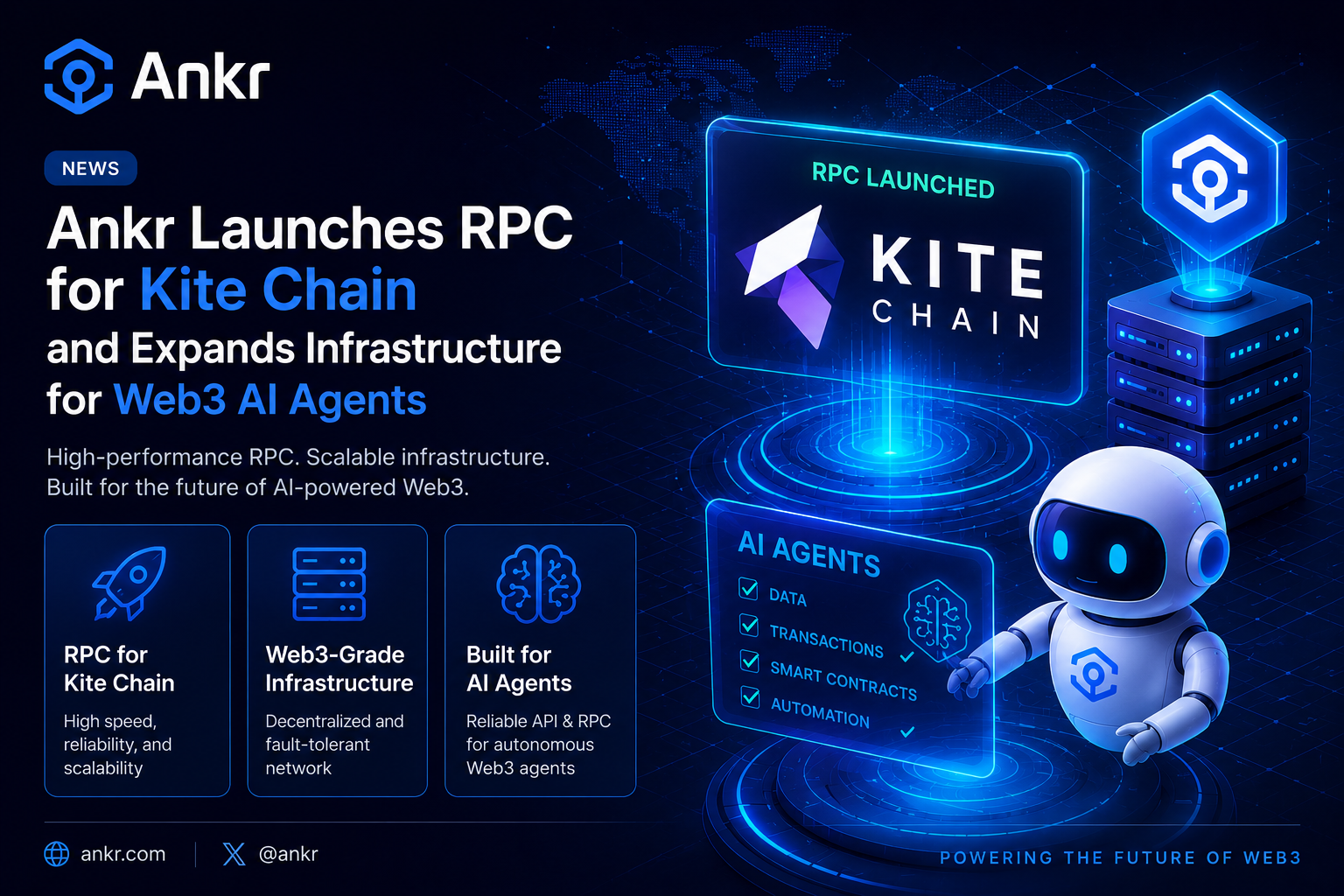
The team at :contentReference[oaicite:0]{index=0} announced the launch of Kite Chain RPC support within its Web3 API service. The new RPC tool will allow developers to connect to the Kite Chain network without the need to deploy and maintain their own node infrastructure.
Kite is a specialized Layer 1 blockchain focused on the development of the agent economy and artificial intelligence-based applications. The network is being designed as an infrastructure foundation for autonomous AI agents that require mechanisms for identity, payments, governance, data verification, and interaction between various digital services.
What Is Kite Chain
Kite Chain is a Layer 1 blockchain specifically developed to support the AI agent economy. The project aims to create an environment where autonomous digital agents can perform operations without constant human involvement.
Within the Kite ecosystem, AI agents can use blockchain technology to store identity data, verify ownership of assets, automate payments, manage smart contracts, and interact with decentralized services.
The project’s developers believe that the agent economy will become one of the key directions of Web3, where autonomous AI systems will independently make payments, interact with services, and execute business processes.
The concept of the agent economy has been gaining momentum alongside the rapid growth of generative AI and autonomous AI assistants. Industry analysts believe that AI agents could eventually become full participants in the digital economy, capable of renting computing power, purchasing datasets, paying for APIs, and interacting with one another without human intervention.
What RPC Means and Why It Matters
RPC (Remote Procedure Call) is a mechanism that allows applications to interact with a blockchain through API requests. Nearly every Web3 application relies on RPC infrastructure to send transactions, retrieve block information, read smart contract data, and verify network state.
Without RPC infrastructure, developers would need to independently run full blockchain nodes, synchronize them, maintain updates, and ensure constant uptime. For many startups and smaller teams, this can become an expensive and technically challenging task.
This is why major infrastructure providers such as Ankr, Infura, and Alchemy have become essential parts of the modern Web3 ecosystem.
Ankr Adds Kite RPC Support
With the launch of Kite RPC by Ankr, developers can send requests to the Kite network and receive responses as if they were operating their own full node. At the same time, the need to maintain infrastructure, updаte nodes, and monitor uptime is completely eliminated.
The RPC service provides reliable, low-latency access to the Kite network for various use cases, including:
- AI-agent applications;
- stablecoin payments;
- machine payment systems;
- automated Web3 services;
- decentralized finance applications;
- digital identity infrastructure.
The company also noted that the infrastructure is designed for high-load scenarios where AI agents must perform large volumes of microtransactions and requests in near real time.
What Developers Gain
Kite Chain RPC by Ankr allows wallets, dApps, platforms, and developer tools to interact directly with Kite network nodes.
RPC endpoints function as a communication layer between applications and the blockchain, giving developers access to the network’s core functionality.
Key Features of Kite RPC
- transaction submission and simulation;
- reading blockchain data and smart contract states;
- retrieving AI agent identity records;
- accessing digital asset information;
- support for AI payment infrastructure;
- interaction with stablecoin applications;
- working with agent payment platforms.
Thanks to the integration, developers can quickly launch services without maintaining their own servers or synchronizing blockchain nodes.
The RPC infrastructure also simplifies scaling. As application demand grows, projects can continue operating through a distributed network of RPC nodes without independently expanding computing capacity.
Why AI Agents Need Blockchain
One of the biggest challenges for autonomous AI systems is trust and the ability to independently interact with services. Blockchain technology helps solve this issue through transparent rules, smart contracts, and decentralized infrastructure.
For example, an AI agent could automatically pay for API requests, rent GPU power, purchase datasets, or settle transactions in stablecoins without human involvement. All operations can be verified on-chain and stored in an immutable ledger.
Blockchain also enables digital identity systems for AI agents. Each agent can have its own crypto wallet, transaction history, reputation systеm, and permission framework for accessing services.
Ankr’s Global Infrastructure
Ankr stated that Kite RPC operates through a geographically distributed network of nodes deployed across multiple regions worldwide. This architecture ensures low latency, stable connections, and high fault tolerance.
For Web3 projects, the speed and reliability of RPC infrastructure are critically important, as any delays or outages directly impact dApps, smart contracts, and user-facing services.
Ankr emphasized that global node distribution is especially important for AI agents that must interact with networks almost in real time.
The company also uses load balancing systems between nodes to automatically redistribute traffic and reduce the likelihood of congestion during periods of high demand.
Ankr Strengthens Its Position in Web3 Infrastructure
Ankr has long been considered one of the largest infrastructure providers in the crypto industry. The company offers RPC, node-as-a-service, and other engineering solutions for dozens of blockchain ecosystems.
Ankr’s infrastructure is trusted by major companies and projects including :contentReference[oaicite:1]{index=1}, :contentReference[oaicite:2]{index=2}, :contentReference[oaicite:3]{index=3}, :contentReference[oaicite:4]{index=4}, :contentReference[oaicite:5]{index=5}, and :contentReference[oaicite:6]{index=6}.
The Ankr network supports more than 75 blockchains and provides a wide range of Web3 tools:
- Web3 APIs and RPC services;
- staking solutions;
- node infrastructure;
- blockchain development tools;
- cloud-based Web3 services;
- DePIN infrastructure solutions.
In addition, Ankr is actively expanding its liquid staking business and participates in the infrastructure of Ethereum, BNB Chain, and other major networks.
The Growth of the AI + Web3 Trend
Interest in AI-focused blockchains and the agent economy has increased significantly amid the rapid expansion of artificial intelligence technologies between 2024 and 2026. The market has seen the emergence of projects combining AI, DePIN, automated payments, and Web3 infrastructure.
Investors increasingly view AI agents as a new class of digital users capable of generating on-chain activity and driving demand for blockchain infrastructure.
Against this backdrop, projects like Kite are attempting to establish themselves as specialized infrastructure platforms for AI services, similar to how Ethereum became the foundational layer for DeFi and NFTs.
Why the Kite RPC Launch Matters
The integration of Kite Chain into Ankr’s infrastructure demonstrates the growing industry interest in AI-oriented blockchains and the emerging agent economy.
In recent months, the market has been actively discussing the use of autonomous AI agents in Web3. Such systems are expected to independently:
- perform financial operations;
- manage digital assets;
- interact with smart contracts;
- purchase computing resources;
- pay for services;
- automatically make decisions based on blockchain data.
To support these scenarios, scalable and reliable infrastructure is required — exactly what Kite and Ankr aim to provide.
Decentralization of Ankr Infrastructure
One of Ankr’s distinguishing features is that the company is building its own global fiber-optic network and blockchain load-balancing systеm for running bare-metal blockchain nodes.
This approach allows Ankr to reduce dependence on centralized cloud providers that may be vulnerable to outages, restrictions, or censorship.
The company positions its architecture as a more resilient and decentralized foundation for next-generation Web3 applications and infrastructure.
This model is especially important for AI-agent infrastructure, where network interruptions could directly impact automated financial operations and digital services.
ANKR Token and Ecosystem
The ANKR token is used within the ecosystem as a DePIN infrastructure asset and is also utilized for service payments, rewards, and interactions with the company’s network services.
Ankr continues expanding the utility of the token. For example, users can participate in staking through the platform’s infrastructure and earn rewards in ANKR.
The token is also used in certain infrastructure access mechanisms and may help incentivize participants in the decentralized node network.
At the time of publication, ANKR is trading around $0.005070, down approximately 0.3% over the past 24 hours.
Market Outlook
Many crypto market participants believe that the next major trend after DeFi and memecoins could be the AI + Web3 sector. Projects are already emerging that focus on:
- autonomous AI trading bots;
- decentralized AI marketplaces;
- agent automation systems;
- AI payment networks;
- machine economy infrastructure;
- protocols for interaction between AI agents.
If the concept of the agent economy achieves mainstream adoption, demand for scalable RPC infrastructure and specialized AI blockchains could grow significantly in the coming years.
Conclusion
The launch of Kite Chain RPC marks another step by Ankr toward expanding its Web3 infrastructure and strengthening its position in the AI-focused blockchain sector.
The integration will allow developers to build applications for the agent economy more efficiently without managing their own node infrastructure. At the same time, it highlights the growing interest within the crypto industry toward AI agents, automated payment systems, and next-generation decentralized services.
Against the backdrop of rapidly evolving artificial intelligence and Web3 infrastructure, projects like these could eventually form the foundation of a new digital economy where autonomous AI systems independently interact with one another through blockchain technology.