



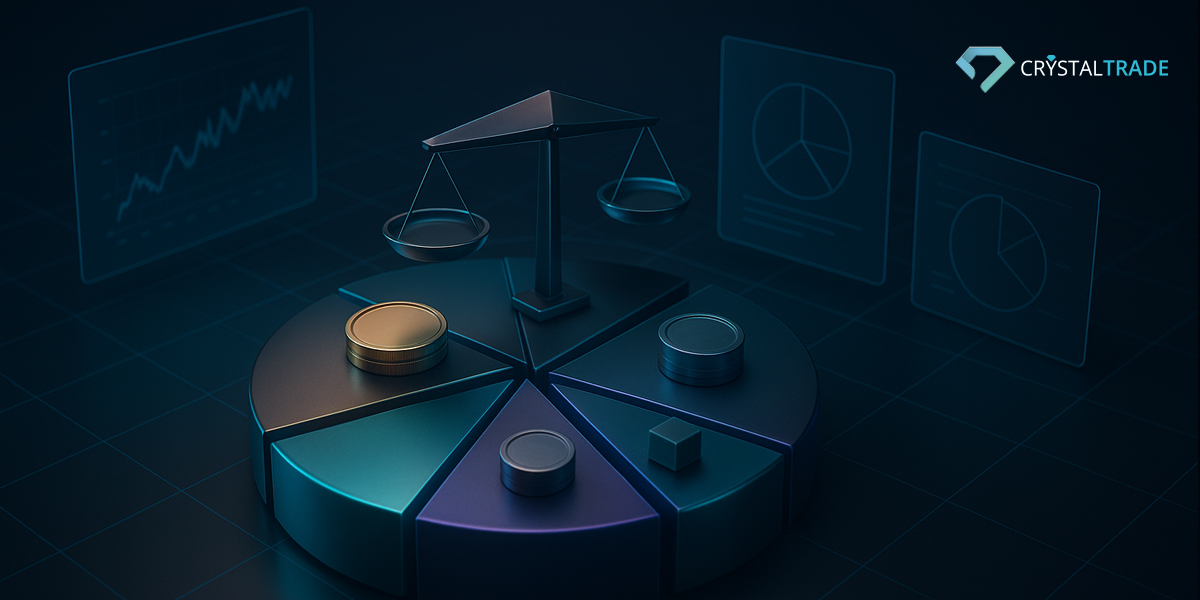
Diversification is the distribution of capital across different “baskets” so that a single setback doesn’t drag the entire portfolio down. In crypto this is especially important due to high volatility and regulatory risks. Below is a complete playbook: the axes of diversification, step-by-step portfolio construction, common mistakes with remedies, example structures for different risk levels, my working mix, and how to keep a portfolio current in a fast-moving market.
Main axes of diversification
- Asset classes. Split capital between BTC/ETH (the liquidity and “benchmark” core), carefully selected altcoins with clear economics and catalysts, and stablecoins as a volatility buffer and dry powder for buys. Cap a single asset at 15–20% of the portfolio; stablecoins typically 10–30%.
- Sectors. Don’t bet everything on one narrative. Use 3–6 areas: DeFi (DEX/lending), infrastructure (L1/L2/oracles), Web3/AI/DePIN/RWA, etc. Let no single sector exceed 35%.
- Geography/jurisdictions. Projects and venues operating under different legal regimes react to shocks differently. Diversify exchanges (CEX/DEX), networks, and teams across regions and regulatory “gravity.”
- Holding horizons. Combine a long-term “Core HODL” (BTC/ETH), medium-term positions in strong alts (3–12 months), and a limited speculative sleeve for event-driven trades. Allocate no more than 10–15% to short-term trading.
- Liquidity and market cap. Keep 60–70% in large/mid caps for turnover and risk control; small caps only with small tickets.
Practical steps to build the portfolio
- Define risk profile and goals. Write down your expected return and maximum drawdown (e.g., target +25% per year with max DD 30%).
- Assemble the “skeleton.” Start with BTC and ETH — the most liquid and predictable part of the market.
- Pick altcoins by checklist only. Evaluate tokenomics (emission, vesting, FDV/MC, unlock calendar), liquidity (volumes, order-book depth), product metrics (TVL, active addresses, developer retention), and catalysts (upgrades, listings, integrations).
- Stablecoin basket. Use 2–3 issuers and 2–3 networks; keep part off exchanges to reduce de-peg/freeze risks.
- Risk limits. One asset = max 15–20% of the portfolio; large positions must use stepwise profit-taking on rallies.
- Rebalancing. Either by calendar (every 30/60/90 days) or by deviation (if a weight drifts 20–25% or more from target). This enforces “sell high / buy low.”
- Costs and custody. Plan fees (prefer L2/low-cost networks), batch transfers, use hardware wallets and 2FA; keep seed phrases in encrypted storage.
- Decision journal. For every trade, record the thesis: what I buy, why, exit trigger, and what invalidates the idea.
Common mistakes and how to fix them
- Concentration in one token/sector. Remedy: strict caps — asset ≤15–20%, sector ≤35%, plus regular rebalancing.
- Buying the hype without checks. Remedy: a 6–8-point checklist; if it fails, no trade.
- No exit strategy. Remedy: pre-set profit ladders (+50% / +100% / +200%) and risk-based stop rules.
- Skipping rebalancing. Remedy: calendar and/or threshold rules you don’t break.
- Single stablecoin issuer or single exchange. Remedy: diversify issuers/networks and venues (CEX/DEX, different regions).
- Ignoring liquidity and fees. Remedy: trade during liquid hours, use careful limit orders, cheaper networks, and batch transfers.
My working mix (example structure)
- 50% — BTC and ETH as the core of liquidity and long-term trend (split 60/40 or 70/30 depending on the cycle).
- 30% — promising altcoins from DeFi, L2, and infrastructure (3–6 projects), each with clear catalysts. Cap per asset: 10–15%.
- 10% — stablecoins to dampen volatility, average down, and seize quick opportunities. Mix issuers and networks.
- 10% — high-risk early plays (AI/DePIN/RWA, etc.) only with small tickets, strict stops, and short horizons.
This layout balances resilience and growth: the core rides the long-term trend, altcoins add beta, stables provide maneuverability, and high-risk bets offer upside with controlled downside.
Three templates for different risk profiles
- Conservative: 60% BTC/ETH, 20% stables, 15% large-cap alts, 5% high-risk. Goal — smooth equity curve and shallow drawdowns; rebalance every 30–60 days, 15% cap per asset.
- Balanced: 50% BTC/ETH, 20% stables, 25% quality alts, 5% high-risk. Goal — compromise between growth and resilience; 20–25% deviation threshold for rebalancing.
- Aggressive: 40% BTC/ETH, 15% stables, 35% growth alts, 10% high-risk. Goal — maximize upside with acknowledged volatility; strict stops and stepwise profit-taking.
(This is not financial advice; adapt to your goals and risk tolerance.)
How I keep the portfolio current
- Weight audit and rebalancing every 30–60 days or when an asset’s weight deviates from target by 20–25% or more.
- Catalyst calendar: network upgrades, vesting/unlocks, listings, integrations — weekly review of theses.
- Liquidity control: before trading, check volumes, depth, and potential slippage.
- Risk control: caps per asset/sector, correlation assessment, and a quick back-of-the-envelope VaR to avoid stealth risk creep.
- Custody security: key audits, 2FA hygiene, hardware wallet firmware updates — quarterly.
- Thesis journal and post-mortems: record entry/exit reasons and review mistakes — this improves discipline and decision quality.
Follow this playbook and you won’t remove volatility from the market — you’ll make it manageable and turn it into a tool for growth instead of a source of chaos.