



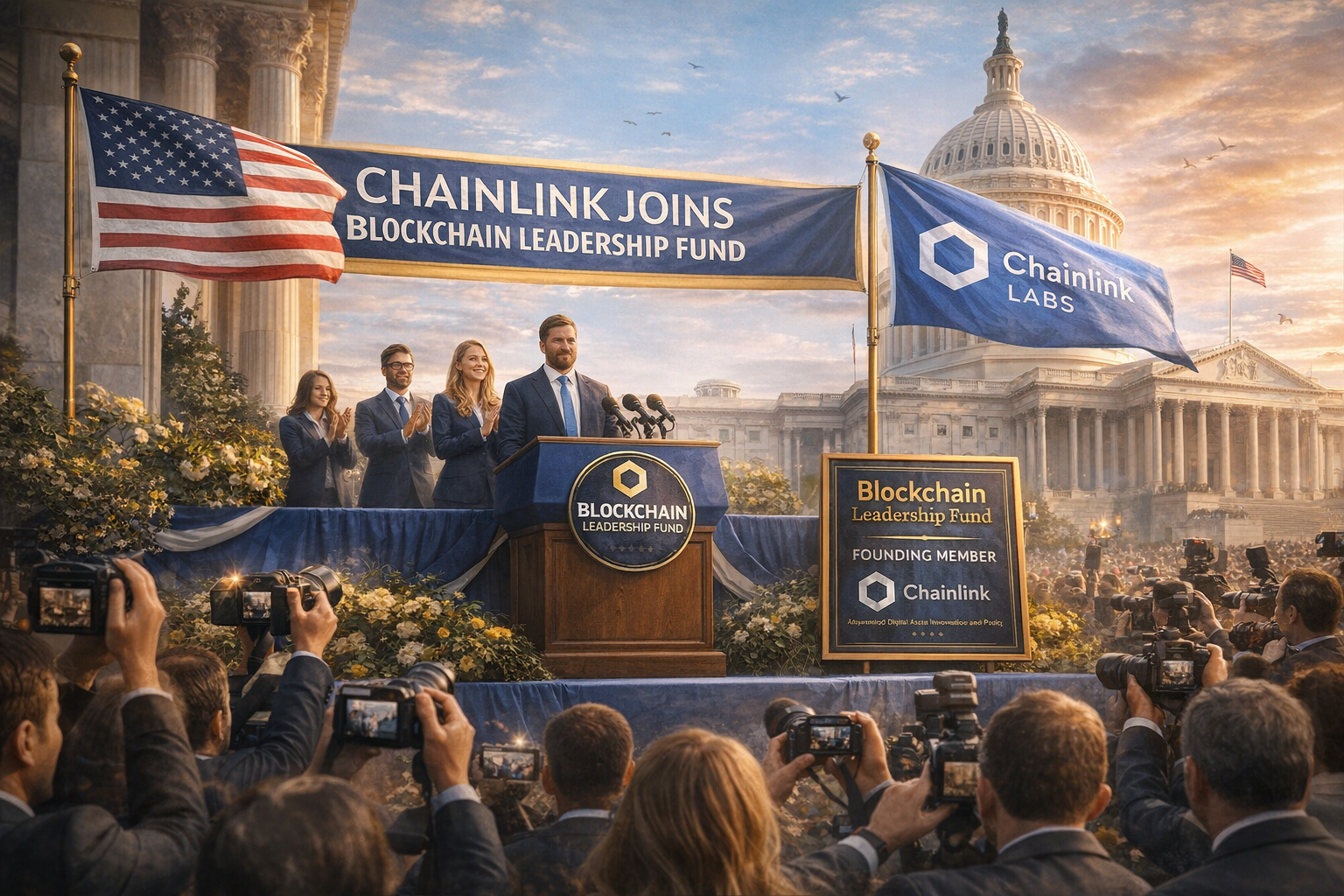
Chainlink announced that Chainlink Labs has joined the Blockchain Leadership Fund (BLF) as one of its founding contributors. This move is aimed at supporting clearer and more favorable U.S. policy on digital assets, blockchain, and next-generation market infrastructure.
For Chainlink Labs, participation in BLF is not just a symbolic political gesture in support of the industry. As U.S. attention to digital asset regulation continues to grow, the company is emphasizing that blockchain innovation must be accompanied by a clearer legal framework. According to market participants, such a framework could accelerate institutional adoption of digital assets and reduce barriers to broader use of blockchain infrastructure.
What the Blockchain Leadership Fund Is
Blockchain Leadership Fund is positioned as an organization focused on advancing the interests of the digital asset ecosystem within the U.S. political systеm. The fund supports pro-innovation candidates, engages voters, and conducts independent advocacy to ensure that blockchain and digital economy representatives are better represented at different levels of government.
This is especially important for the industry at a time when the United States continues debating rules around digital assets, token classification, market structure, and acceptable models of interaction between crypto companies, banks, custodians, and traditional financial institutions. In practice, this means BLF is seeking to influence not only the broader narrative around the crypto industry, but also the more specific conditions under which infrastructure projects, tokenization services, and institutional-grade blockchain solutions will develop.
Why BLF Membership Matters Specifically for Chainlink Labs
For Chainlink Labs, joining the fund looks like a logical continuation of its long-term strategy. The company has long positioned itself as an infrastructure layer connecting blockchain environments with external data, cross-chain messaging, payment logic, and the services required for financial applications to operate both in DeFi and in more traditional financial settings.
That is why regulation is not an abstract issue for Chainlink, but a very practical one. The clearer the U.S. rules for digital assets become, the easier it will be for institutional participants to use solutions related to tokenization, onchain data delivery, cross-chain interoperability, and smart contract-based automation.
BLF and the Topic of Institutional Digital Asset Adoption
Chainlink’s statement places particular emphasis on the idea that greater clarity around market structure could accelerate institutional adoption of digital assets. This is an important point, because the institutional segment has increasingly been viewed as one of the main potential sources of long-term growth for blockchain infrastructure.
Large financial institutions, banks, payment companies, custodial platforms, and infrastructure providers are only willing to work more actively with digital assets if they clearly understand the legal framework and compliance requirements surrounding such operations. In this context, Chainlink Labs joining BLF can be seen not only as support for the industry as a whole, but also as a step toward creating more favorable conditions for future demand for the company’s own infrastructure.
Chainlink Strengthens Its Position as Infrastructure for Onchain Finance
Chainlink has long been regarded as one of the key infrastructure projects in the blockchain sector. Historically, it has been known primarily as an oracle network that supplies smart contracts with external data. Today, however, Chainlink’s positioning is much broader.
The company is increasingly promoting itself as standard infrastructure for connecting traditional financial systems with blockchain environments. This goes beyond market data delivery and includes a broader range of functions: cross-chain messaging, automated settlement logic, support for tokenized assets, infrastructure for stablecoins, and the tools needed to scale onchain finance.
Why This Matters Especially in the Context of Tokenization
One of the main themes Chainlink has been emphasizing in recent years is real-world asset tokenization and the development of infrastructure for institutional blockchain use. Traditional financial firms are increasingly viewing tokenization as a way to improve settlement efficiency, simplify interaction between platforms, and expand the possibilities of managing digital representations of real-world financial instruments.
Within this model, Chainlink is trying to secure a role as the infrastructure bridge between existing financial systems and onchain architecture. That is why participating in policy and industry advocacy through BLF looks logical for the company: if the U.S. truly moves toward a clearer regulatory model for digital assets, that could create additional opportunities for the adoption of the solutions Chainlink is already bringing to market.
The Fund Reflects a Broader Trend of Political Consolidation in the Crypto Industry
The news that Chainlink Labs has joined BLF also highlights a broader trend: major crypto and infrastructure companies are becoming increasingly active in U.S. political processes. The industry is gradually moving away from a model in which the primary focus was only on technology and products, and is increasingly recognizing that the regulatory and political environment has a direct impact on business growth.
That is why organizations like BLF are becoming tools for the industry not only for reputational support, but also for strategic influence. The more actively the sector participates in shaping the rules of the game, the greater the chances that future laws and regulatory approaches will be compatible with the development of blockchain technology and digital assets.
What This Could Mean for LINK and the Chainlink Ecosystem
Although the news is primarily about strategy and policy, it also matters for how the broader Chainlink ecosystem is perceived. The more visibly the company strengthens its role as part of future regulated digital infrastructure, the stronger its position becomes as a long-term technology provider for the financial sector.
For the LINK token, this kind of development does not necessarily imply an immediate market reaction. However, in a broader sense, it reinforces the narrative that Chainlink is building not just a standalone blockchain service, but a full infrastructure standard for onchain finance, tokenization, and institutional interaction with digital assets.
Conclusion
Chainlink Labs joining the Blockchain Leadership Fund shows that the company is becoming increasingly active not only in the technological development of the industry, but also in its policy and regulatory evolution. For Chainlink, this is a step toward a stronger presence in the part of the market where blockchain’s future depends not only on code and integrations, but also on what the rules of the game will look like in the world’s largest economy.
If BLF is indeed able to influence the creation of a clearer digital asset market structure in the United States, that could potentially strengthen the position of companies already building infrastructure for institutional blockchain use. In that sense, Chainlink Labs is seeking to become not just a technology participant in the market, but one of the architects of the future onchain financial systеm.
This material is for informational purposes only and does not constitute financial, investment, or any other form of advice.